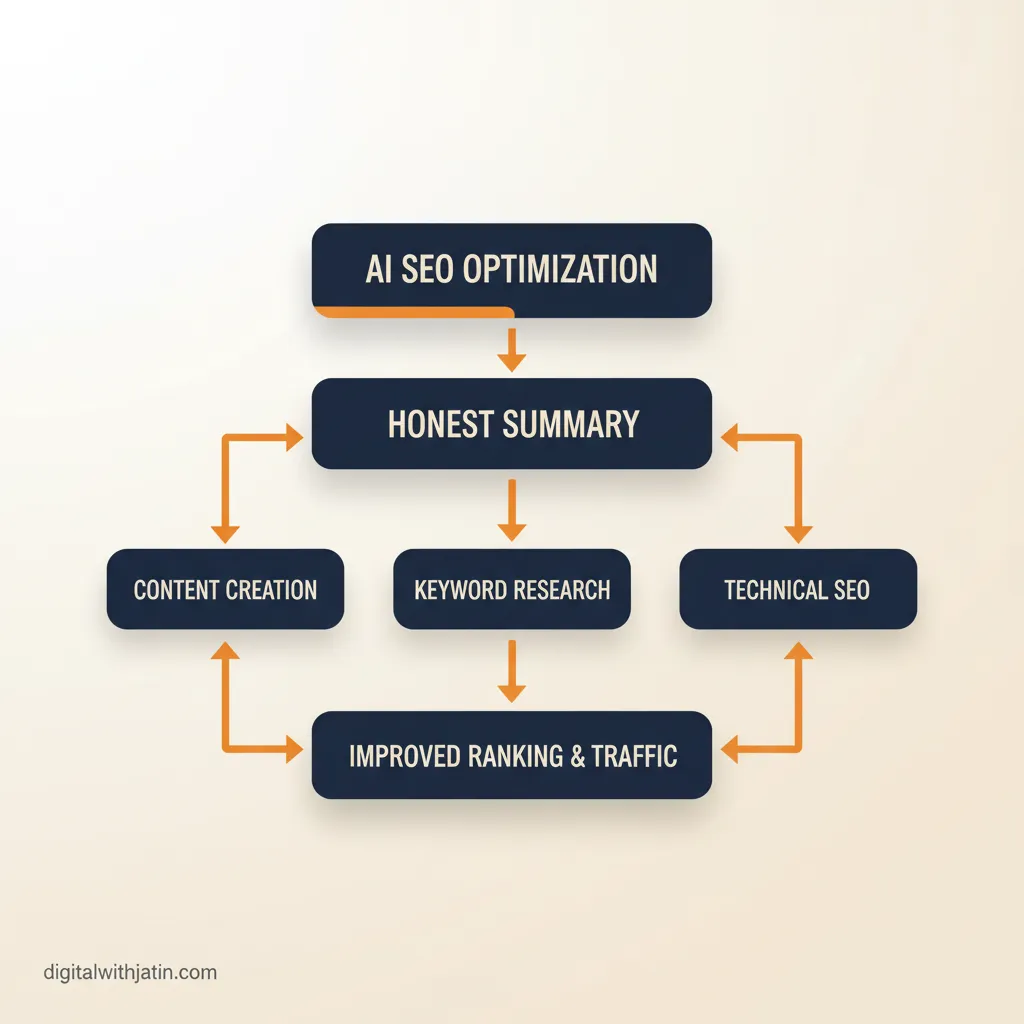
- AI compresses the execution layer of SEO: auditing, drafting, schema, keyword clustering, and internal link mapping can all be partially or fully automated.
- The 7 highest-value tasks to automate are audit triage, content briefs, first-draft generation, schema markup, metadata batch updates, keyword clustering, and internal link suggestions.
- AI still cannot replace human judgment on strategy, positioning, brand voice, and deciding what is worth publishing.
- The right workflow uses AI for repeatable execution and humans for decisions that require experience and context.
The SEO tasks that consume the most time are usually the ones that require the least thinking. Pulling competitor headings, writing 40 meta descriptions, generating schema blocks, triage-ing a 200-row audit export. These are execution tasks. They have clear inputs, clear outputs, and a success condition you can verify. That makes them the right tasks to automate.
The question of how can AI help with SEO optimization has a practical answer: it compresses the execution layer. What used to take a day of focused work can take an hour when AI handles the first pass and a human handles the review.
Here are the seven tasks where that compression is real, the tools that handle each, and what humans still need to own.
The direct answer
Direct answer: AI helps with SEO optimization by automating seven specific tasks: audit triage, content brief generation, first-draft content, schema markup, batch metadata updates, keyword clustering, and internal linking mapping. For each task, AI handles the first pass; a human reviews before anything goes live. The result is faster execution on the repeatable work, with human judgment reserved for strategy, positioning, and decisions that require context.
Anthropic’s research on building effective agents identifies the same principle: simple, targeted agents with clear success conditions outperform complex orchestration every time. The seven tasks below are chosen because each one has a clear success condition you can verify without ambiguity.
Task 1: Audit triage
An SEO audit export from Screaming Frog or Sitebulb can return thousands of rows. The manual work is reading through them, deciding which issues matter, and grouping them by priority. AI can do that triage step in minutes.
The workflow: export the crawl data as CSV, pass it to Claude or ChatGPT with a prompt that defines the priority criteria (crawl errors over redirect chains over missing metadata, for example), and ask for a grouped, prioritized summary. The output is a triage report that would take a junior auditor two to three hours to produce manually.
This does not replace a human reading the results. It replaces the mechanical sorting step so the human can start at the analysis layer rather than the organization layer.
Tools: Screaming Frog or Sitebulb for the crawl, Claude or ChatGPT for triage.
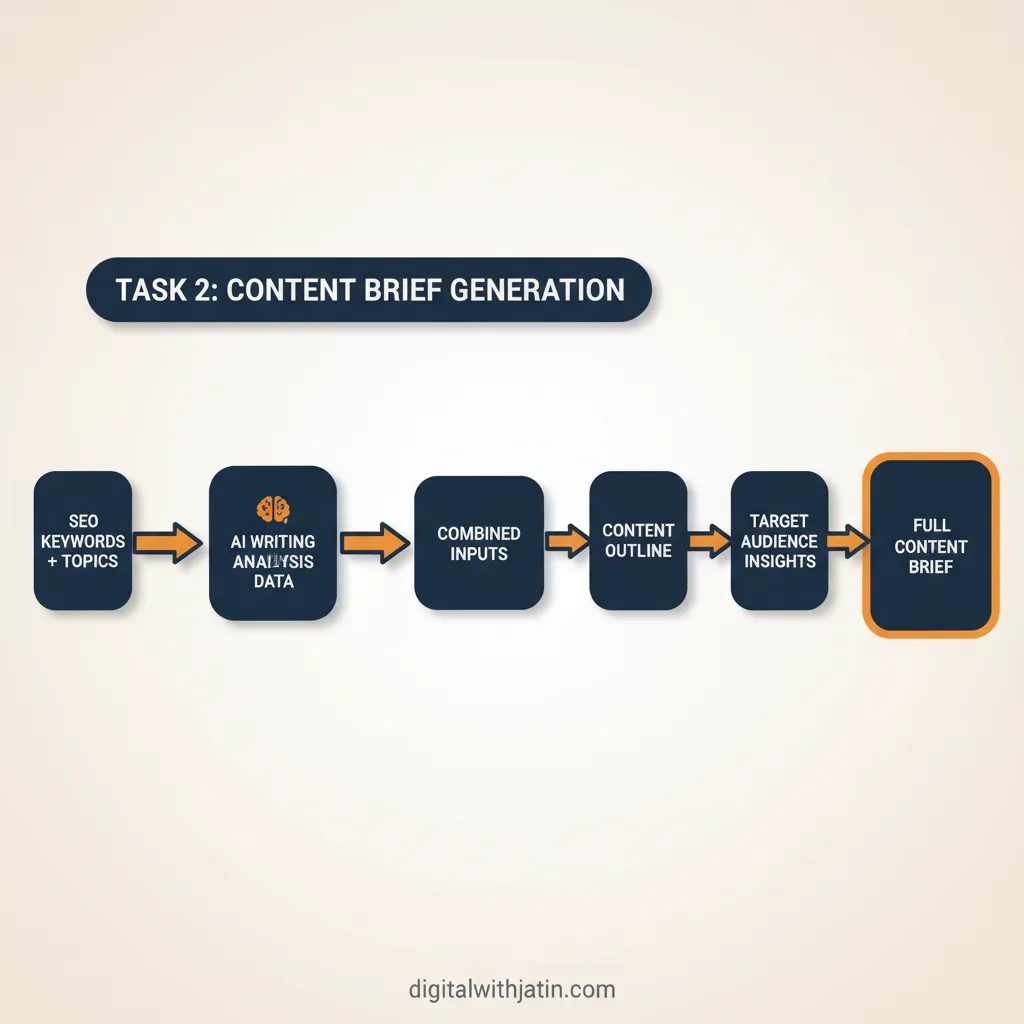
Task 2: Content brief generation
A content brief for a single keyword takes 20 to 40 minutes to build manually: SERP analysis, competitor heading extraction, intent classification, word count benchmark, internal link suggestions, FAQ identification. AI can compress that to five minutes.
The workflow: take the target keyword, the top 5 competing URLs, and the site’s existing content map, then run a prompt that asks for intent classification, recommended structure, heading outline, and a list of internal links to include. The output is a first-pass brief. A human reviews it for strategic fit, angle, and whether the recommended structure actually matches the intent better than what is already ranking.
The brief generation step is where most teams see the fastest time savings from AI for seo optimization.
Tools: Ahrefs or Semrush for competitor data, Claude or ChatGPT for brief generation.
Task 3: First-draft content
Given a detailed brief, AI generates a first draft. This is covered in depth in how to use AI agents in SEO, but the core point is the same here: the draft needs a human editorial pass before it is publishable. The AI removes the blank-page problem. The human adds the original insight, verifies the statistics, and aligns the voice.
The human editorial pass is not optional. It is the step that makes the content worth ranking. AI drafts without editorial review are generic by default, and generic content is the pattern that underperforms in both classic and AI search.
Tools: Claude or ChatGPT for drafting, human editor for the QC pass.
Task 4: Schema markup generation
Give an AI model the page content and ask for FAQPage, Article, or HowTo JSON-LD. It returns a complete schema block in under a minute. Validate it with the Google Rich Results Test. Fix any field errors (the AI occasionally misses a required field). Publish.
This task used to take 15 to 20 minutes per page. With AI, it takes two minutes plus validation time. For a site with 50 pages needing schema, the time saving is meaningful.
The connection to AI citation is direct: structured data is one of the six SEO foundations that feeds AI search citation, and schema generation is the most time-consuming part of implementing it at scale.
Tools: Claude or ChatGPT for generation, Google Rich Results Test for validation.
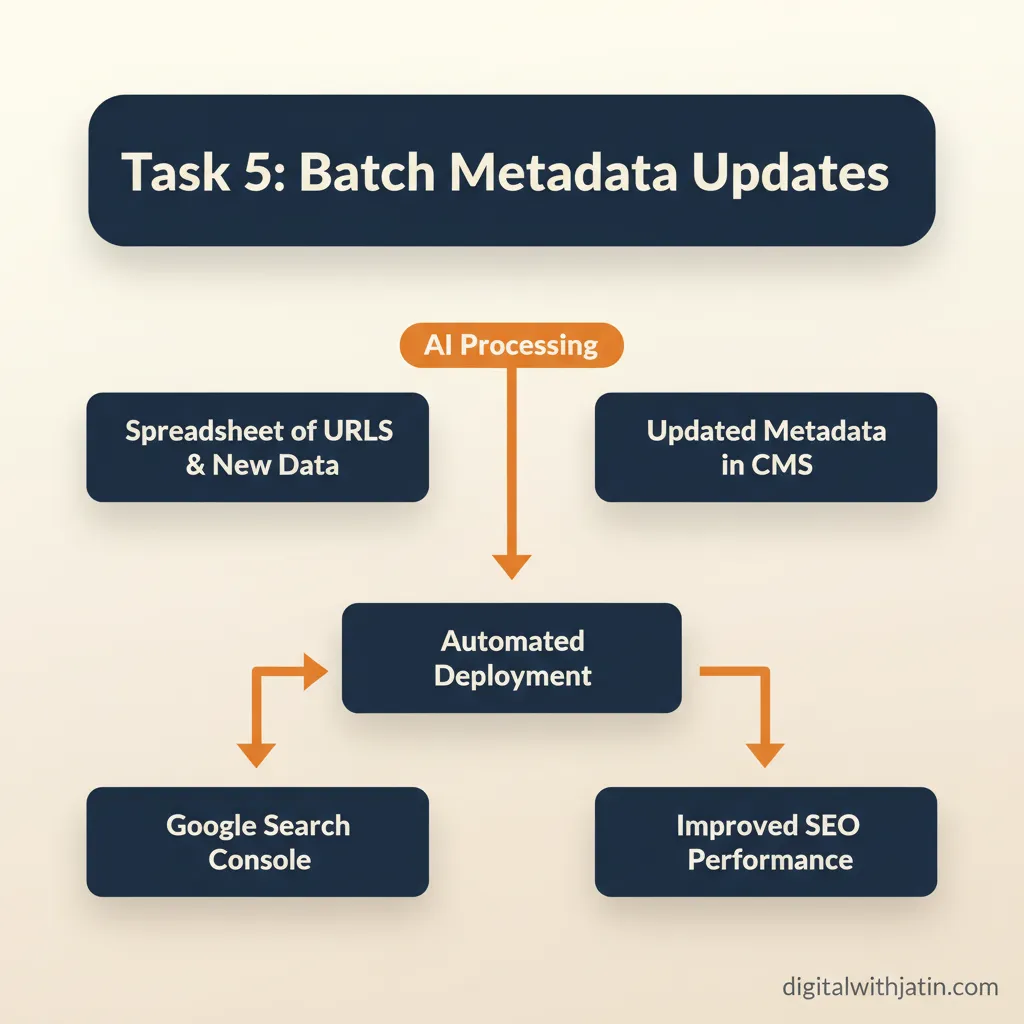
Task 5: Batch metadata updates
Refreshing title tags and meta descriptions across 30 to 100 pages is a task most teams deprioritize because it is time-consuming and low-glamour. AI makes it fast enough to actually do.
The workflow: export the current metadata from Search Console or the CMS, pass it to Claude with the focus keyword for each page and the character limits, ask for three variants per page (title and description), then pick the best variant per page and update. The whole process for 50 pages runs in under an hour.
Tools: Google Search Console for the export, Claude or ChatGPT for generation, CMS for the update.
Task 6: Keyword clustering
Given a list of 100 to 500 keywords from a keyword research export, AI can group them into topic clusters based on shared intent. This is faster than manual clustering and catches groupings a human might miss because they are looking at the list linearly.
The limitation is that AI cannot assess keyword difficulty or volume. It only sees the terms you give it. The clustering step still needs to be followed by a human filtering the clusters against actual search volume and difficulty data in Ahrefs or Semrush. But the cluster structure itself can be AI-generated reliably.
Tools: Ahrefs or Semrush for the keyword export, Claude or ChatGPT for clustering.
Task 7: Internal link suggestions
Given a new piece of content and a list of existing pages on the site, AI can suggest which existing pages should link to the new one and which pages the new one should link to. It can also identify anchor text variants that match the focus keywords of the linked pages.
This does not replace a human checking whether the suggested links are contextually appropriate. But it replaces the manual process of reading through the site’s content map and making those connections by hand.
The internal link graph is a key signal for topical authority in AI search, so this task has a direct connection to citation performance, not just classic SEO ranking.
Tools: Claude or ChatGPT for suggestions, human review for contextual appropriateness.
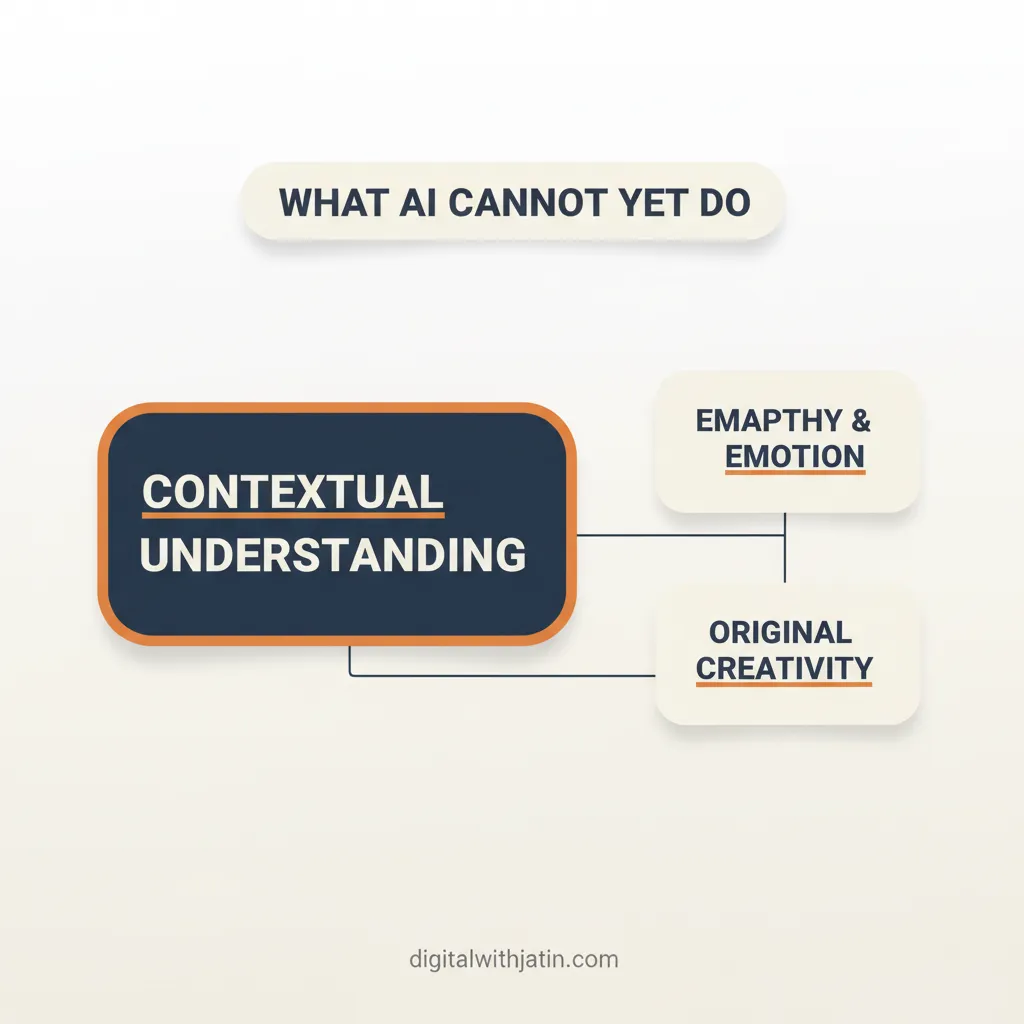
What AI still cannot handle
Three categories of SEO work are not automatable with current tools:
Strategy. Deciding what to build, which topics to own, where to compete and where to yield, and how to sequence work based on the site’s current authority and competitive position. These decisions require context that AI does not have: business model, margin profile, competitive dynamics, team capacity.
Positioning. Deciding the angle for a piece of content, the voice, and the specific observation that makes the page worth reading instead of just another entry in the index. This is judgment work, not execution work.
Performance interpretation. Reading a month’s Search Console data and deciding what it means for the next three months of content work. AI can summarize the data. It cannot decide what the pattern means for the specific site, audience, and business situation.
The AI SEO overview and the AI agents in SEO workflow both frame this the same way: AI handles execution between judgment points. The judgment points are still human.
Building the workflow
The practical sequence for using AI for seo optimization without creating a fragile, error-prone pipeline:
- Start with one task. The most repetitive thing in your current workflow. Audit triage and schema generation are the easiest entry points.
- Define the success condition before you build the workflow. “Schema passes the Rich Results Test” is a clear condition. “The content is good” is not.
- Run the AI step, then review every output for the first 20 to 30 runs. This tells you where the model is consistently reliable and where it needs human correction.
- After 30 runs, automate only the sections that passed consistently. Keep the human gate on everything else.
- Add a second task once the first is stable. Do not try to automate five tasks simultaneously.
This is the same build pattern I use for client work, where the goal is a system that runs reliably over months, not a demo that works once. The technical SEO automation context goes deeper on the technical audit side specifically.
FAQ
How does AI help SEO?
AI helps SEO by automating the repetitive execution tasks that consume time without requiring human judgment: first-draft content, schema markup generation, metadata updates, audit triage, and keyword clustering. It frees the time and attention that would otherwise go to those tasks for the strategic work that AI cannot do.
What AI tools help with SEO optimization?
The most practical stack as of 2026: Claude or ChatGPT for content drafting and schema generation, Ahrefs or Semrush for keyword and link data, n8n or Make.com for workflow automation, and Google Search Console for performance measurement. No single tool covers the full pipeline. The value is in how they connect.
Can AI do on-page SEO?
AI can generate and validate the components of on-page SEO: title tags, meta descriptions, heading structure, FAQ generation, internal link suggestions, and alt text optimisation. It cannot audit page speed, check Core Web Vitals, or measure how on-page changes affect rankings after the fact. Those still require dedicated tools and a human reading the data.
How much of SEO can AI automate?
Roughly 60 to 70 percent of the execution layer (drafting, formatting, schema, metadata, and audit triage) can be automated or AI-assisted. The remaining 30 to 40 percent is judgment-dependent: what angle to take, what to publish and what to kill, how to interpret performance data, and how to position content for a specific audience.
What should humans still do in SEO optimization?
Strategy, positioning, editorial judgment, performance interpretation, and client or stakeholder communication. Humans decide what to build, why a particular angle is right for the audience, whether the AI output meets the quality bar, and what the data means for the next decision. AI handles the execution between those judgment points.
The honest summary
AI for SEO optimization earns its place in the workflow by compressing execution time on tasks that are well-defined and verifiable. The seven tasks above account for a significant share of the hours most SEO practitioners spend on non-strategic work. Automating them does not remove the need for SEO expertise. It removes the execution friction that keeps that expertise from being applied where it matters.
If you want to see this workflow applied to a specific site, the AI SEO service is where I take clients through the setup, from tool selection to the first stable automated pipeline.