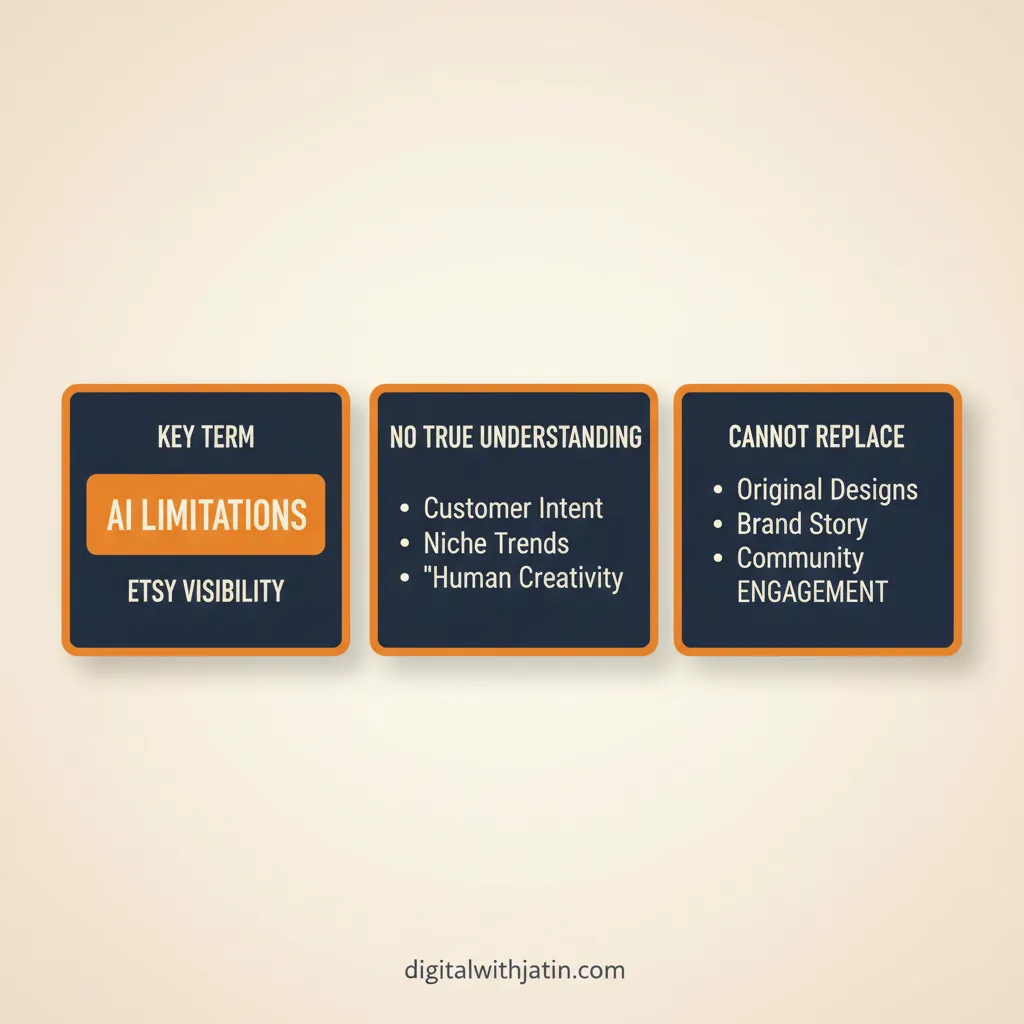
- AI tools help with Etsy SEO execution: writing keyword-first listing titles, generating tag variations, and drafting benefit-led descriptions faster.
- Etsy's ranking algorithm is separate from Google. AI helps with listing copy but cannot improve the sales velocity, recency, and review signals that actually drive Etsy visibility.
- For Etsy-specific keyword data, use eRank or Marmalead. Do not rely on general keyword tools for Etsy search volume.
- The honest scope: AI on Etsy is an execution speed tool, not a visibility strategy on its own.
Etsy seo ai is the frame for this post. A handmade ceramics seller I came across in a forum was spending four hours per week rewriting Etsy listings by hand. She had taken a course on Etsy SEO, had eRank set up, and understood which keywords she needed to target. The problem was purely execution time: moving keyword research into polished listing titles and descriptions across 80 active products was a manual grind. She asked whether AI could help. The honest answer is yes for that specific problem, and no for most of the others that Etsy sellers tend to ask about in the same breath.
Etsy SEO and AI
AI tools help with Etsy SEO in a specific and limited scope: writing keyword-first listing titles, generating tag variations, and drafting benefit-led listing descriptions at execution speed. They do not improve the sales velocity, recency, review signals, or shipping competitiveness that Etsy’s ranking algorithm weights most heavily. Understanding that boundary is the starting point for using AI on Etsy without misplaced expectations.
How Etsy’s Search Algorithm Actually Works
Before applying any tool to Etsy SEO, the algorithm needs to be understood clearly, because it is fundamentally different from Google’s.
According to Etsy’s seller handbook (etsy.com/seller-handbook), Etsy search ranking is driven by: relevancy (how well the listing’s title, tags, and description match the search query), listing quality score (a composite of conversion rate, favourites, and engagement signals), recency (newly listed or recently renewed listings receive a temporary visibility boost), and shipping price (listings with free or competitive shipping receive a ranking benefit).
Listing quality score is where most Etsy sellers lose ground over time. It reflects how buyers respond to a listing when it appears in search. If buyers click but do not purchase, the quality score drops. If buyers convert at a strong rate relative to similar listings, the quality score rises. Reviews and repeat purchases feed into this over time.
AI can help with relevancy (by getting the right keywords into the right positions in titles and tags) and partially with listing description quality (by producing copy that communicates value clearly). It has no effect on listing quality score, recency, or shipping signals. Those are operational decisions, not copy decisions.
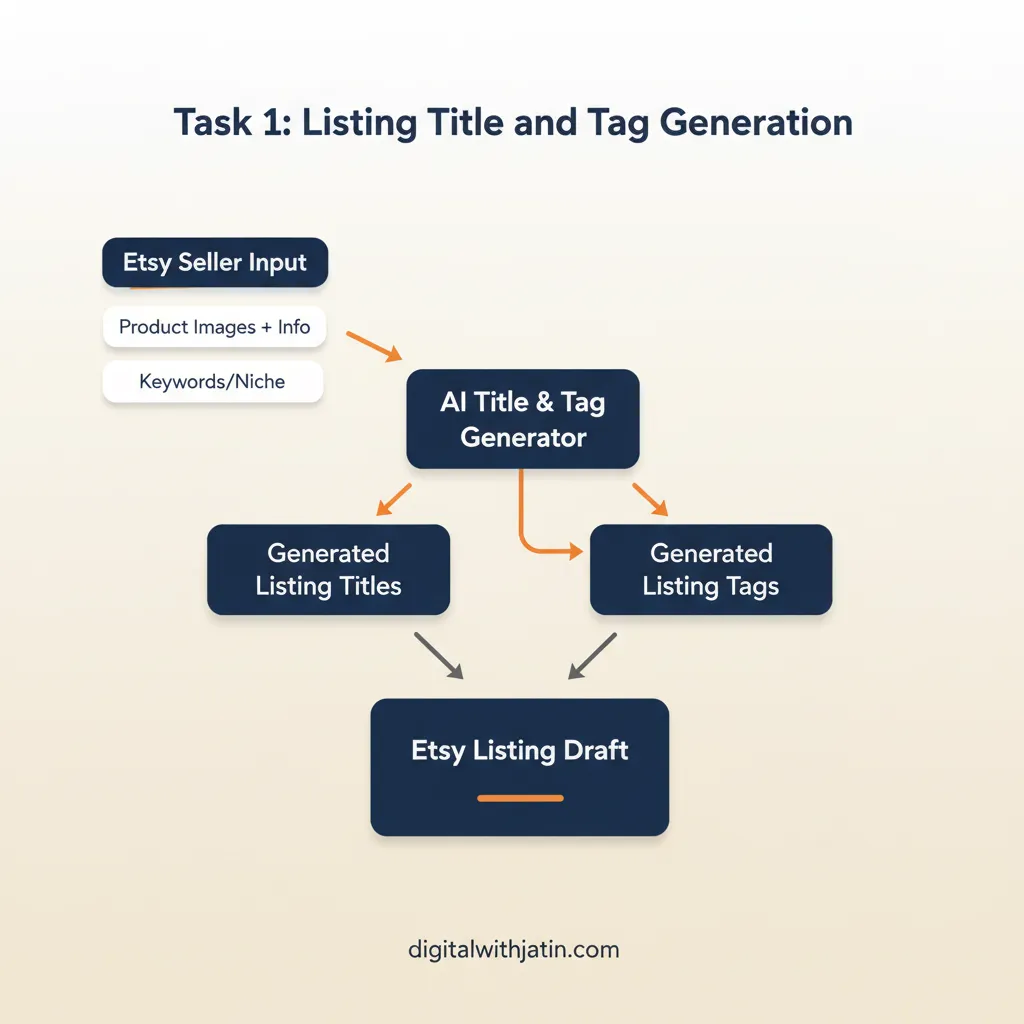
Task 1: Listing Title and Tag Generation
This is where AI tools deliver the most direct time saving for Etsy sellers.
The Etsy listing title has a 140-character limit. The primary keyword should appear at the start of the title. Secondary keywords and product specifics fill the remainder. A poorly structured title either buries the primary keyword or stuffs keywords without natural phrasing, both of which reduce click-through rate even when the listing does rank for the right terms.
The workflow with Claude: provide your product description (what the product is, materials, size, any unique feature), your top keywords from eRank or Marmalead ranked by search volume and competition, and the 140-character constraint. Ask Claude to produce three title variations that lead with the primary keyword, incorporate the secondary keyword, and describe the product in specific, buyer-facing language. Then review, test, and choose.
The same workflow applies to tags. Etsy allows 13 tags per listing, each up to 20 characters. Claude can generate 25 to 30 tag phrase candidates from a product description and keyword list in seconds. You then run those candidates through eRank to check actual Etsy search volume, remove the low-volume ones, and pick the 13 strongest. This turns a 20-minute per-listing process into a five-minute one.
The ceramics seller reduced her weekly listing update time from four hours to under 90 minutes using this workflow, while improving keyword coverage because the AI was generating tag variations she had not thought to include manually.
Task 2: Finding Long-Tail Etsy Search Terms
The keyword tools that most digital marketers use (Ahrefs, Semrush, Google Keyword Planner) are not accurate for Etsy. They measure Google search volume, which reflects what people search in a browser. Etsy search volume reflects what buyers type inside the Etsy platform, and these are often different.
A search for “personalised ceramic mug” on Google might show high volume. The same term on Etsy might be extremely competitive with low conversion rates. A longer-tail term like “custom ceramic coffee mug handmade gift UK” might have lower Etsy volume but a much higher purchase intent and lower competition within the platform.
eRank and Marmalead pull data directly from Etsy’s search. They show search volume within Etsy, competition level, and trend data for specific terms. These are the tools to use for Etsy keyword discovery. General keyword tools are not substitutes.
AI assists with the clustering and expansion step, not the data step. Once you have a list of 30 to 50 keyword candidates from eRank, Claude can group them by intent, identify which ones belong in titles versus tags versus descriptions, and suggest long-tail combinations from shorter seed terms. This is the same keyword clustering function AI tools perform in Google SEO, applied to an Etsy keyword list.
The combination that works: eRank or Marmalead for data, Claude for clustering and variation generation. Neither tool alone covers both jobs.
Task 3: Writing Listing Descriptions That Match Etsy’s Algorithm
Etsy’s listing description has two distinct jobs. The first 160 characters are used as a meta description in Google search results (Etsy pages can and do rank on Google, particularly for specific product searches). The rest of the description communicates product details, care instructions, and purchase information to buyers who click through from Etsy search.
The algorithm weight on description text for Etsy’s internal search ranking is lower than on titles and tags. But the description matters for conversion, and conversion feeds listing quality score. A description that clearly communicates what the product is, who it is for, the specific dimensions and materials, and the benefit to the buyer reduces purchase hesitation and improves the click-to-purchase ratio.
AI helps here with speed and structure. The description writing prompt for Claude: product name and primary keyword first sentence, then materials and dimensions, then the specific use case or buyer benefit, then care or delivery information. Ask for 250 to 350 words, benefit-led, with the primary keyword in the first two sentences. Claude produces a usable draft in 30 seconds. The seller reviews for accuracy and voice, adjusts the tone to match their brand, and publishes.
The critical editorial check: AI does not know your product’s actual specifications. Materials, dimensions, weight, and turnaround time must be accurate, and Claude will sometimes hallucinate plausible-sounding but incorrect specifics if the input brief is vague. Always review for factual accuracy before publishing.
What AI Cannot Do for Etsy Visibility
Being direct about this matters because Etsy sellers can waste significant time optimising listing copy while ignoring the signals that actually determine whether listings rank and convert.
Sales velocity is the accumulation of purchases on a listing over time. New listings start with a recency boost that fades. Listings with a track record of conversions maintain ranking. No amount of copy optimisation recovers a listing that is not selling. If a product is not converting, the problem is usually pricing, photography, product-market fit, or shipping cost, not the keyword in the title.
Reviews are part of listing quality and seller trust signals. A listing with strong recent reviews outperforms an equivalent listing without them regardless of how keyword-optimised the copy is. Getting reviews requires fulfilling orders promptly, communicating with buyers, and delivering a product that matches the listing description.
Recency gives new or recently renewed listings a temporary boost in search. Some sellers renew listings manually to capture this boost. AI has no role in this. It is an operational tactic, not a copy tactic.
Etsy’s star seller status (based on response time, order completion rate, and review scores) affects search visibility for those sellers who qualify. Again, this is a fulfilment and communication metric, not a content metric.
The honest assessment: AI makes listing copy work faster and often better than a seller doing it manually without keyword discipline. It does not change the business fundamentals that Etsy’s algorithm actually rewards.
For context on how AI tools assist with broader SEO workflows beyond platform-specific use cases, the post on how to use AI agents in SEO covers the execution layer in more depth.
Does AI help with Etsy SEO?
Yes, in a specific scope. AI tools like Claude help write keyword-first listing titles, generate tag candidates from a product description, and draft benefit-led descriptions faster than manual writing. They do not improve the sales velocity, recency, or review signals that drive Etsy’s ranking algorithm. AI is an execution speed tool for listing copy, not a complete Etsy visibility strategy.
What is Etsy’s search algorithm based on?
According to Etsy’s seller handbook (etsy.com/seller-handbook), Etsy ranking is based on relevancy (keyword match between query and listing), listing quality score (conversion rate and engagement signals), recency (newer or recently renewed listings get a temporary boost), and shipping competitiveness. Sales history and reviews feed into listing quality score over time.
Which keyword tools work for Etsy SEO?
eRank and Marmalead are the tools built specifically for Etsy keyword research. They pull search volume data from within Etsy’s platform. General keyword tools like Ahrefs or Google Keyword Planner measure Google search volume, which does not correspond to how buyers search inside Etsy.
How do I use AI to write Etsy listing titles?
Provide Claude with your product description, your top keywords from eRank ranked by volume and competition, and Etsy’s 140-character title limit. Ask for three title variations that lead with the primary keyword, incorporate a secondary keyword, and describe the product specifically. Review, test, and choose the most natural-sounding version.
What are Etsy tags and how do AI tools help with them?
Etsy allows 13 tags per listing (up to 20 characters each). AI tools generate 20 to 30 tag phrase candidates from a product description and keyword seed list. You then check each candidate against eRank for actual Etsy search volume and select the 13 strongest. This turns a 20-minute manual process into a five-minute one.
Does AI-generated listing copy hurt Etsy SEO?
No. Etsy does not have the equivalent of Google’s Helpful Content evaluation for listing copy. Etsy evaluates listings on keyword relevance and conversion signals. If the AI-generated copy is accurate, specific, and keyword-matched, it functions identically to human-written copy in Etsy’s ranking system.
What does AI not help with in Etsy SEO?
AI does not improve sales velocity, recency signals, review count, or shipping competitiveness. These are the factors that determine long-term Etsy visibility. AI speeds up listing copy production but has no effect on the operational decisions (pricing, photography, fulfilment speed, review generation) that Etsy’s algorithm most heavily weights.
The ceramics seller cut her weekly listing update time from four hours to 90 minutes. She published 15 new listings in the time she used to spend updating 10. Her conversion rate improved modestly because the descriptions were more specific and the keyword coverage was more consistent. Six months later, she attributed the time saving more than the ranking change as the primary value. That is the honest outcome. AI made the execution faster and more consistent. The business fundamentals that drive Etsy visibility were already in place because she was running a good operation.
If you want to see how AI execution tools are applied across a broader digital presence beyond a single platform, the AI SEO services page covers the full workflow.