- AI Overviews appear on informational queries. Transactional and navigational queries mostly still return classic SERPs.
- CTR drops are real on some informational queries. The honest answer is that the data varies by query type, and fabricating specific percentages helps no one.
- Being cited inside an AI Overview is a separate optimization target from ranking in the top 10. Both matter.
- Getting cited requires direct-answer blocks, FAQPage schema, named entities, and primary-source citations. Ranking alone is not enough.
Search “how long does it take to rank on Google” and you will get an AI Overviews that gives a range, cites two or three sources, and answers the question without requiring a click. The pages cited in that Overview get brand exposure without a visit. The pages not cited, including some that rank in the top 5, get nothing from that query.
That is the specific dynamic worth understanding. It is not that SEO is broken. It is that a subset of queries now has a two-layer result: a citation layer and a rank layer. Winning only the rank layer on those queries is a narrower win than it used to be.
How Google AI Overviews Will Affect SEO: The Direct Answer
Google AI Overviews affect google ai overviews seo in two ways, one negative for some sites and one positive for others. Sites with heavy informational query traffic will see CTR changes on queries where AI Overviews appear and answer the question without a click. Sites that optimize for passage citation will gain a new visibility channel that did not exist before.
The honest answer on CTR numbers is that observed impacts vary significantly by query type, site, and how much of the answer the Overview covers. Anyone giving you a specific “X% drop” as a universal figure is working from a single study that does not generalize. The ai overviews impact seo differently across different content types.
Which Queries Trigger AI Overviews
Google announced AI Overviews for general availability in May 2024, initially in the US with broader expansion since. The pattern of which queries trigger them is observable and consistent.
Informational queries with a clear synthesizable answer trigger AI Overviews most reliably. “How does photosynthesis work,” “what is a canonical tag,” “how is google ai overviews going to affect seo,” these are the query shapes that get Overviews.
Transactional queries largely do not. A search for “buy Sony WH-1000XM5” returns product listings, ads, and comparison pages. No AI Overview. Google’s interest is in synthesizing information, not in inserting a generated answer between a buyer and a product page.
Navigational queries (searching for a brand name or specific website) return the site directly. AI Overviews are not designed for this query type.
Local queries (“best coffee near me,” “plumber in Ahmedabad”) mostly return the local pack and Maps results. AI Overviews appear occasionally on more general local information queries but not on “near me” intent.
The practical implication for ai overviews impact seo on your site: pull your Search Console impressions by query type and estimate how much of your traffic is informational. That is the portion most affected by AI Overviews. If most of your traffic is transactional or navigational, the impact is smaller than the headlines suggest.
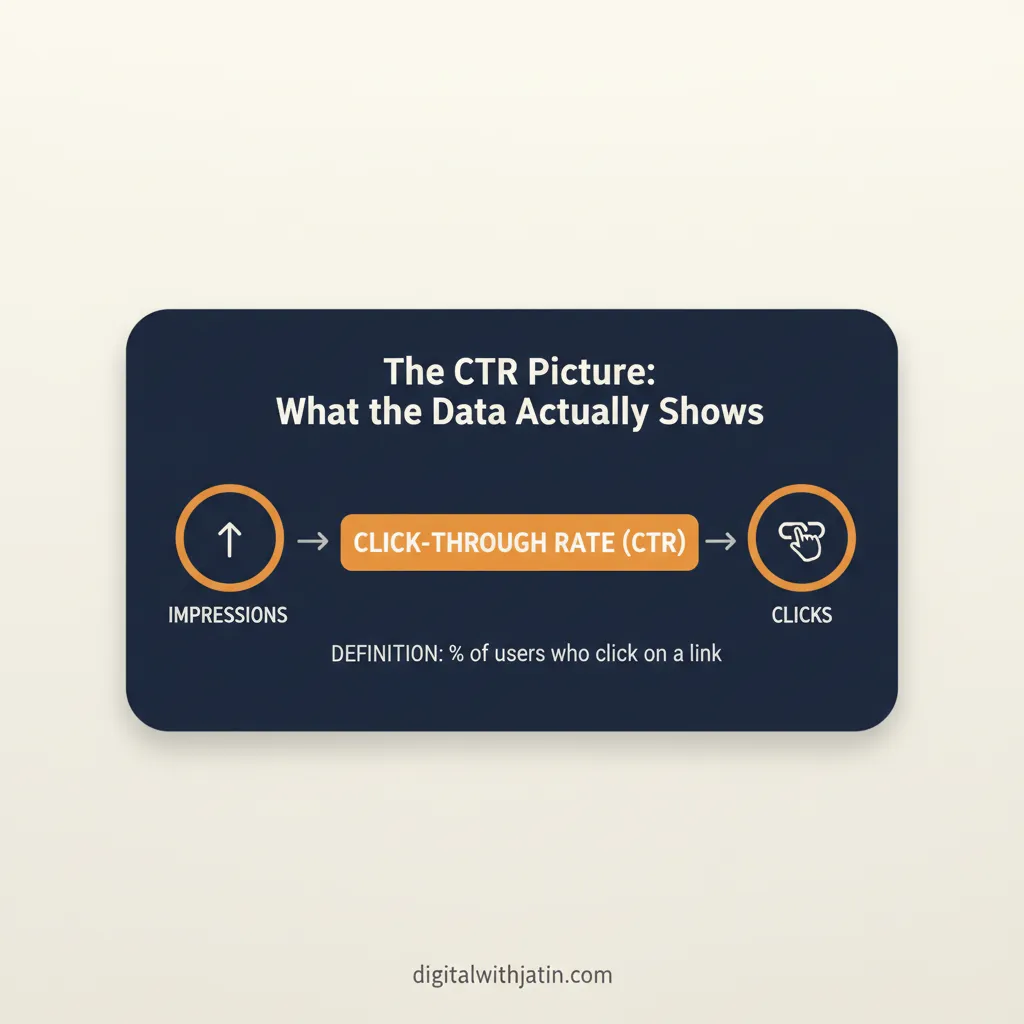
The CTR Picture: What the Data Actually Shows
I am not going to cite a percentage here because the figures that circulate are each from different query sets, different markets, and different time periods. Some studies show significant CTR drops on informational queries. Others show citation sources gaining traffic. Both can be true simultaneously for different queries on the same site.
What is observable and consistent across the sites I have worked on:
Pages cited inside AI Overviews tend to maintain or grow impressions on the cited query even when CTR is lower, because the citation keeps the brand visible. Over time, that brand visibility builds recall separately from the click metric.
Pages that rank but are not cited on queries with AI Overviews see the biggest CTR pressure. Position 3 through 10 on a query where positions 1 and 2 are cited in an Overview is a harder position than it was before AI Overviews existed.
Queries where the Overview does not fully answer the question still drive clicks. An Overview that covers the definition of a topic but not the implementation steps sends clicks to the pages that cover implementation. This is why depth still wins: a surface-level overview answer does not replace a 2,000-word practical guide.
The Citation Opportunity
Getting cited in Google AI Overviews is a separate optimization target from ranking, and it is achievable for pages that are not at position 1. This is the positive side of the ai overviews impact seo equation that most coverage ignores.
Google’s AI Overview pulls passages from indexed pages. The selection criteria are observable: pages that answer the query directly, use structured data, cite sources, and write FAQ answers that stand alone tend to earn more citations than pages that bury the answer in marketing copy.
The passage-level requirements for how to show up in AI Overviews seo are:
A direct-answer block in the first 200 words. Write 40 to 60 words that answer the query plainly. No hedging, no marketing voice. This is the block AI Overviews pull most often. Place it under the first H2, not in the introduction.
FAQPage and Article schema. Structured data tells the retrieval system what each block is. An unlabeled FAQ section is harder to parse than one with FAQPage JSON-LD. Validate with the Google Rich Results Test before publishing.
Primary-source citations on every stat. A passage that asserts a number without a source is less citable than one that links the number to an authoritative origin. The retrieval step weights attributable claims.
Named entities instead of vague references. “According to Google Search Central” is more citable than “according to Google’s official documentation.” The named entity is what the retrieval system uses to confirm the passage is authoritative on the topic.
Allow Google-Extended in robots.txt for AI crawlers. Google-Extended is the crawler Google uses for AI training and AI Overviews grounding. Blocking it blocks your eligibility for citation. Check your robots.txt now if you have not done this recently.
For the full passage-level optimization workflow, the AI SEO playbook covers each step with examples.
How to Respond as an SEO Practitioner
The strategic response to AI Overviews is not to panic and not to ignore them. It is to adjust on two fronts.
First, audit your query mix. Use Search Console to identify which of your high-impression queries are now returning AI Overviews. Search those queries manually and note whether your pages are cited or not. This is the baseline. Queries where you rank but are not cited are the highest-priority optimization targets.
Second, rewrite for passage citation. For each of those target queries, rewrite the relevant page with a direct-answer block, standalone FAQ entries, and inline citations. Re-submit to Search Console for crawling. Check citation status after two to three weeks.
Third, expand into citation-friendly formats. Queries that trigger AI Overviews tend to reward comparative posts, step-by-step guides, and definition posts with direct answers. If your content is mostly opinion or narrative, add a direct-answer block at the top and a structured FAQ at the bottom without rebuilding the whole post.
Fourth, track citations, not just rankings. A rank tracker cannot tell you whether your pages appear in AI Overviews. Add a visibility tracking tool to your stack. See how to show up in ai overviews seo for the specific workflow I run on client sites, and the AI SEO service for full-scale implementation.
FAQ
How do AI Overviews affect SEO traffic?
On informational queries where AI Overviews appear, some pages see lower CTR because the answer is visible without a click. On the same queries, pages cited as sources inside the AI Overview gain brand visibility even when the user does not click. The net effect on your traffic depends on your query mix: heavy informational query traffic is more affected than transactional or navigational traffic.
Does ranking #1 still matter with AI Overviews?
Yes, but it is no longer sufficient on its own for informational queries. Ranking #1 increases eligibility for the AI Overview citation, but pages ranked #3 through #10 also earn citations when their passage structure is cleaner. Focus on both: maintain or build rank, and optimize the passage structure that AI Overviews pull from.
Which types of queries are most affected by AI Overviews?
Informational queries, especially those that begin with “how,” “what,” “why,” and “which,” trigger AI Overviews most often. Transactional queries (“buy X,” “X price,” “X near me”) and navigational queries (brand name searches) are less affected. Google’s focus is on queries where a synthesized answer adds value, not on queries where a direct result is the right response.
How do I get cited in AI Overviews?
Place a direct-answer block of around 50 words in the first 200 words of the post. Add FAQPage and Article schema. Cite primary sources for every numeric claim. Write FAQ answers that stand alone without context. Allow Googlebot and Google-Extended in your robots.txt. Being cited is a passage-level optimization, not a page-level one.
Will AI Overviews replace the regular search results?
No. Google’s official position is that AI Overviews complement the standard search results, not replace them. The blue links, featured snippets, and People Also Ask boxes still appear below or alongside AI Overviews. Google’s business model depends on clicks driving ad revenue, which creates a structural limit on how much the traditional SERP can be reduced.
The honest picture of how is google ai overviews going to affect seo is this: the impact is real but uneven. It falls hardest on informational content that answers simple queries and leaves nothing left to click for. It creates a new citation opportunity for content that is structured to be pulled and attributed. Both of those are true at the same time.
Audit your query mix first. That tells you whether the first dynamic or the second is more relevant to your site right now.