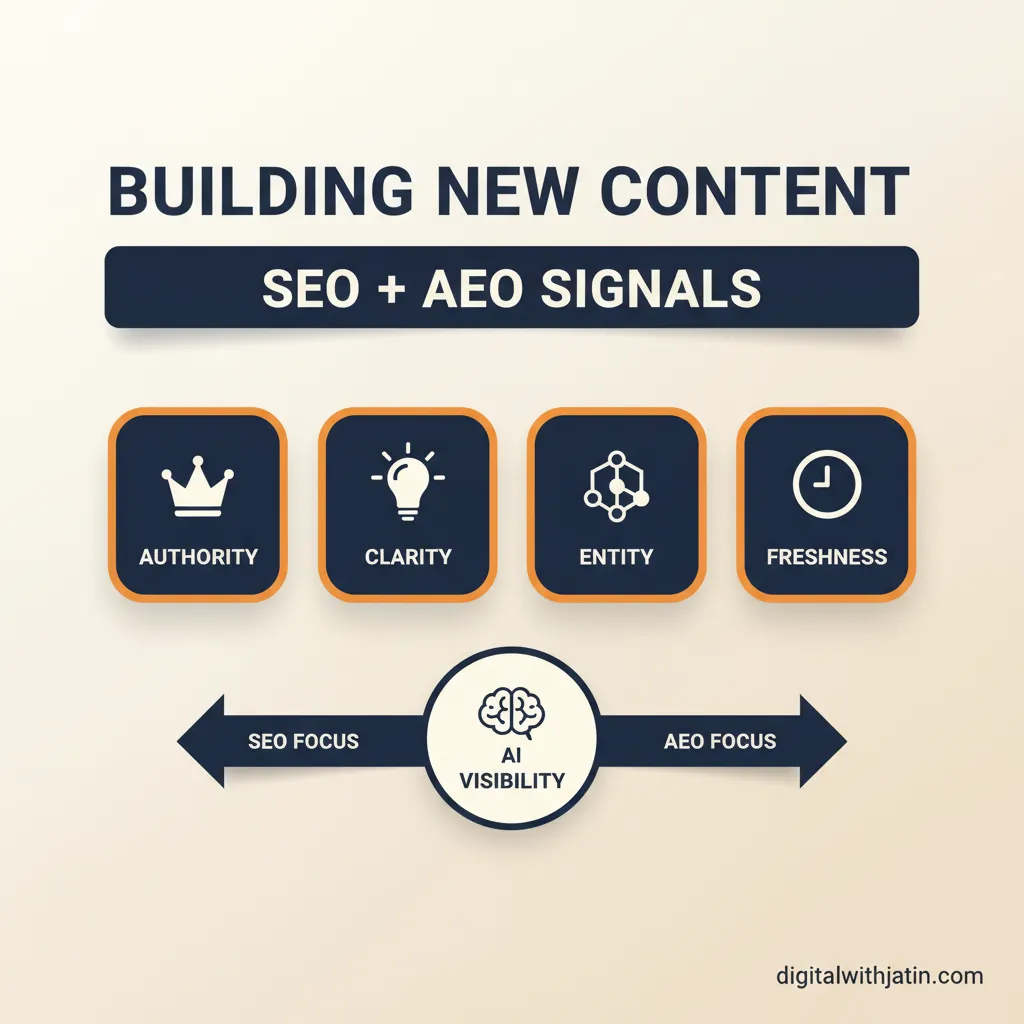
- SEO and AEO share 80% of the same signals. You are not rebuilding your strategy: you are extending it.
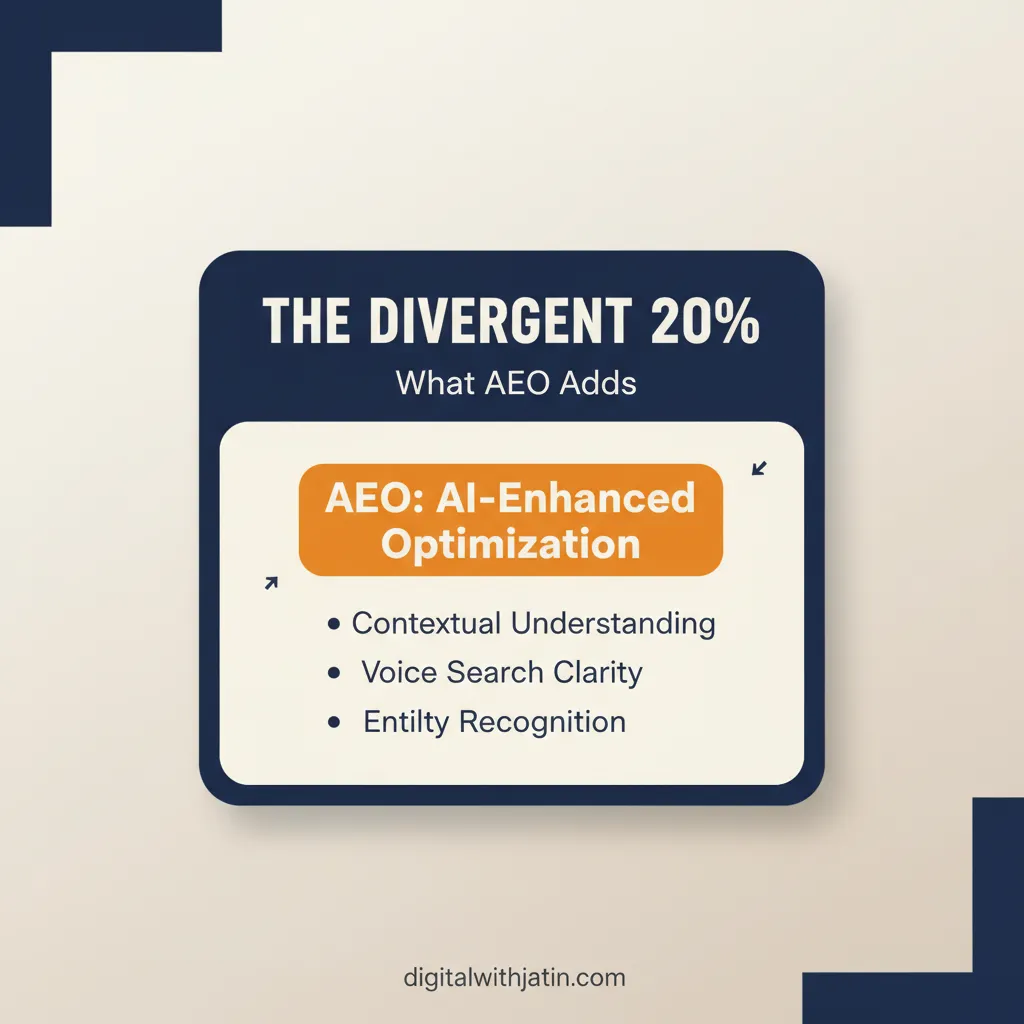
- The 20% that differs: AEO requires standalone FAQ answers, a 50-word direct-answer block, and FAQPage schema. SEO does not require these.
- The practical merge: run your existing content through the AEO checklist and add the missing elements. Most posts need 3 changes, not a rewrite.
- Measurement is where teams fall short. Citation share tracking (Profound, Otterly) must sit alongside rank tracking or you are blind to half the result.
The challenge of how to merge seo and aeo for ai visibility is that most teams treat them as separate workstreams. A brand I worked with last year had strong classic SEO metrics: position 1 on several commercial terms, solid domain authority, consistent organic traffic. When AI Overviews started appearing on informational queries in their category, their traffic on those queries dropped noticeably. They were ranking but not being cited.
The fix was not a strategy rebuild. It was three additions to each informational post: a 50-word direct-answer block in the opening, FAQPage schema, and inline citations for every stat. The existing SEO foundation was already doing most of the work. The AEO layer was the missing 20%.
How to Merge SEO and AEO for AI Visibility: The Direct Answer
SEO and AEO share 80% of the same signals. Crawlability, topical authority, structured data, E-E-A-T, and backlink authority all contribute to both rank and AI citation eligibility. The 20% divergence is three specific additions AEO requires that classic SEO does not: a 50-word standalone direct-answer block in the first 200 words of each post, FAQPage JSON-LD with self-contained answers, and inline primary-source citations for every stat. Merging SEO and AEO means running the AEO checklist on existing content, then building new content with both sets of requirements from the start.
The Shared 80%: What You Are Already Doing
If you have been running a standard SEO programme, the following signals are already working for AEO as well.
Crawlability and indexability. AI search surfaces pull from the same index Google’s classic algorithm uses. If Googlebot can reach and index a page, it can appear in AI Overviews. Blocked pages, orphan URLs, and noindex tags remove content from both classic and AI search simultaneously.
Topical authority. AI Overviews favour sites that have published multiple pieces on the same subject over sites with isolated posts. This mirrors the way classic Google rewards topical depth. The cluster you build for SEO is the same cluster that signals AEO authority.
Structured data. Article schema, HowTo schema, and BreadcrumbList schema all contribute to AI search citation eligibility. If you have already implemented structured data for rich results, you have a portion of the AEO schema layer complete.
E-E-A-T signals. Named authors with credentials, about pages, author schemas, and primary-source citations are the signals Google’s quality rater guidelines describe for evaluating source trustworthiness. These matter for both classic ranking and AI citation selection.
Backlink authority. AI search systems do not use a separate link graph from the classic one. A site with strong topical backlink authority is more likely to be cited than a site without it.
All of this is the foundation. How AI is changing SEO covers the full picture of what has shifted and what has not.
The Divergent 20%: What AEO Adds
Three specific additions distinguish AEO-optimized content from SEO-only content.
Addition 1: The 50-Word Direct-Answer Block
Place a standalone 40 to 60 word answer to the post’s primary question in the first 200 words. The answer must be complete without the surrounding article. No phrases like “as I explain below” or references to headings that appear later.
This is the passage AI Overviews most commonly extract. The first-200-words placement is not arbitrary. AI retrieval systems weight early passages more heavily than mid-page content when establishing what a page is fundamentally about.
Writing this block requires asking: if someone saw only this paragraph, would they have a useful answer? If yes, the block is ready. If no, rewrite it until yes.
Addition 2: FAQPage Schema with Standalone Answers
FAQPage JSON-LD makes individual Q-and-A pairs machine-readable as self-contained units. Google AI Overviews can extract a single Q-A pair from this schema without reading the surrounding page.
The critical constraint: every answer in the FAQPage schema must stand alone. No pronouns that reference the article title. No “as mentioned above.” Each answer is a complete, context-free response to the question.
Validate the schema with Google’s Rich Results Test before publishing. A malformed FAQPage block does not contribute to citation eligibility.
Addition 3: Inline Primary-Source Citations
For every numeric claim, link directly to the original research, report, or official documentation. Not a summary article reporting on the research. The source itself.
AI systems prefer to cite pages that cite others. A page with five verified, linked statistics is more citation-eligible than a page with the same statistics presented without attribution. Remove any claim you cannot source. A page with three sourced statistics is stronger than a page with ten unsourced ones.
The Practical Merge Workflow
For existing content, the merge is a checklist applied post-publication:
- Open the post. Check whether the first 200 words contain a direct-answer block. If not, add one.
- Check whether the post has FAQPage JSON-LD. If not, add it with 4 to 5 Q-A pairs drawn from the body.
- Check whether every stat has an inline link to a primary source. Fix any that reference secondary summaries or have no citation at all.
- Check whether the Article schema includes a named author with a URL. If not, add it.
That is the full AEO audit for a page that already has solid SEO fundamentals. Most posts require 3 to 4 changes. Almost none require a full rewrite.
For new content, write with both checklists from the brief stage. The additional AEO requirements add 15 to 20 minutes to the content production process: not a separate workflow.
The Measurement Gap
The most common failure in merging SEO and AEO is measuring only one layer. Teams add AEO optimizations, check rank, and conclude the work had no effect: because rank is the wrong metric for the AI layer.
Citation share is the metric. On informational queries where AI Overviews appear, the question is not “did our rank improve?” It is “are we being cited inside the AI Overview for this query?”
Profound, Otterly, and AthenaHQ track citation share. The top AI SEO tools breakdown covers each tool in detail. Without a citation tracking tool, the AEO work is invisible in the reporting: which is why most teams undervalue it.
Building New Content for Both Signals from Day One
Once the existing content is updated, new content should be built with both SEO and AEO requirements as standard.
A content brief for a dual-optimized post includes:
- Primary keyword (for SEO targeting)
- Query intent classification (informational, commercial, navigational)
- 50-word direct-answer block drafted at the brief stage
- 5 FAQs with standalone answers drafted at the brief stage
- External sources to cite (minimum 3, primary sources only)
- FAQPage and Article schema drafted at the brief stage
The brief is longer than a purely SEO-focused brief. The post takes marginally longer to write. The output is eligible for both classic rank and AI citation from the moment it is indexed.
The AI SEO guide covers the full system. If you want the dual-signal workflow implemented for your site, the AI SEO service handles setup and ongoing management.
FAQ
What is the difference between SEO and AEO?
SEO targets rank position in standard search results. AEO targets citation inside AI-generated answer surfaces: Google AI Overviews, ChatGPT, and Perplexity. Both share the same technical foundation. AEO adds three specific requirements: a 50-word standalone direct-answer block, FAQPage schema with self-contained answers, and inline primary-source citations for every stat.
Do I need a separate AEO strategy from my SEO strategy?
No. AEO is an extension of SEO, not a replacement. The crawlability, topical authority, structured data, E-E-A-T signals, and backlink work you do for SEO all contribute to AEO citation eligibility. The additional AEO-specific work is a checklist of 3 to 4 page-level changes: direct-answer block, FAQPage schema, standalone FAQ answers, and inline source citations.
How does AEO help with Google AI Overviews?
AEO optimizes the passage structure that Google AI Overviews pull from. A direct-answer block in the first 200 words gives AI Overviews a clean extraction target. FAQPage schema makes Q-and-A pairs machine-readable. Inline citations signal source reliability. Together, these signals raise the probability that a specific passage from your page appears inside the AI Overview for relevant queries.
What is citation share and why does it matter?
Citation share is the percentage of relevant queries on which your pages appear as cited sources inside AI Overviews, ChatGPT, or Perplexity search visibility. On informational queries where AI Overviews appear, citation share is the metric that tells you whether your content is winning that layer, independent of rank.
Which comes first: SEO or AEO?
SEO foundation first. AI search systems index and retrieve from the same web Googlebot indexes. If a page cannot be crawled, it cannot be cited. If a site has no topical authority, it loses citation competitions to sites that do. Build the SEO foundation, then layer the AEO additions. Running AEO optimizations on a technically broken site produces no citation benefit.