- AI search does not replace the SEO foundations. It makes them harder to cut corners on.
- Crawlability, structured data, named entity clarity, passage structure, internal linking, and freshness signals are the six foundations that feed AI citation directly.
- A page that fails on crawlability or entity clarity is invisible to both classic search and AI search simultaneously.
- Technical SEO is not less important with AI. It is the prerequisite that everything else depends on.
A pattern I see on audit work: teams spend hours on content strategy for AI search, then discover their site is partially blocked to GPTBot, has no structured data, and uses vague entity references throughout. The AI citation problem is not a content problem. It is a foundation problem.
The question of what elements are foundational for SEO with AI does not have a new answer. It has the same answer as classic SEO, with a higher floor on each element and less tolerance for shortcuts. Here is the breakdown, ordered by impact.
The direct answer
Direct answer: The foundational SEO elements for AI search are crawlability and indexation, structured data, named entity clarity, passage-level content structure, internal linking depth, and freshness signals. All six existed before AI search. AI search makes the cost of ignoring each one higher, because AI systems are less forgiving of ambiguity than a classic ranking algorithm.
The Google Search Central SEO starter guide covers the crawlability and indexation layer in detail. What follows is how each foundation connects specifically to AI citation, which is the layer the starter guide predates.
For context on the broader AI SEO strategy this fits into, the AI SEO overview is the starting point.
Foundation 1: Crawlability and indexation
This is not optional and it is not negotiable. An AI search system sources its answers from pages it has crawled and indexed. A page blocked in robots.txt, returned with a noindex directive, or excluded from the sitemap is invisible. It cannot earn an AI citation. It cannot rank in classic search. It does not exist from the system’s perspective.
The specific point for AI search is that AI crawlers are separate from Googlebot. GPTBot, ClaudeBot, PerplexityBot, and Google-Extended each have their own user-agent strings. A robots.txt that allows Googlebot but blocks all others will still rank in classic search but earn no AI citations. Check each user-agent explicitly. If your business stance is to allow AI grounding but not AI training, that is a legitimate choice, but it must be implemented at the file level, not assumed.
This is the foundation that feeds everything else. If crawlability is broken, every other optimization is pointless.
Foundation 2: Structured data
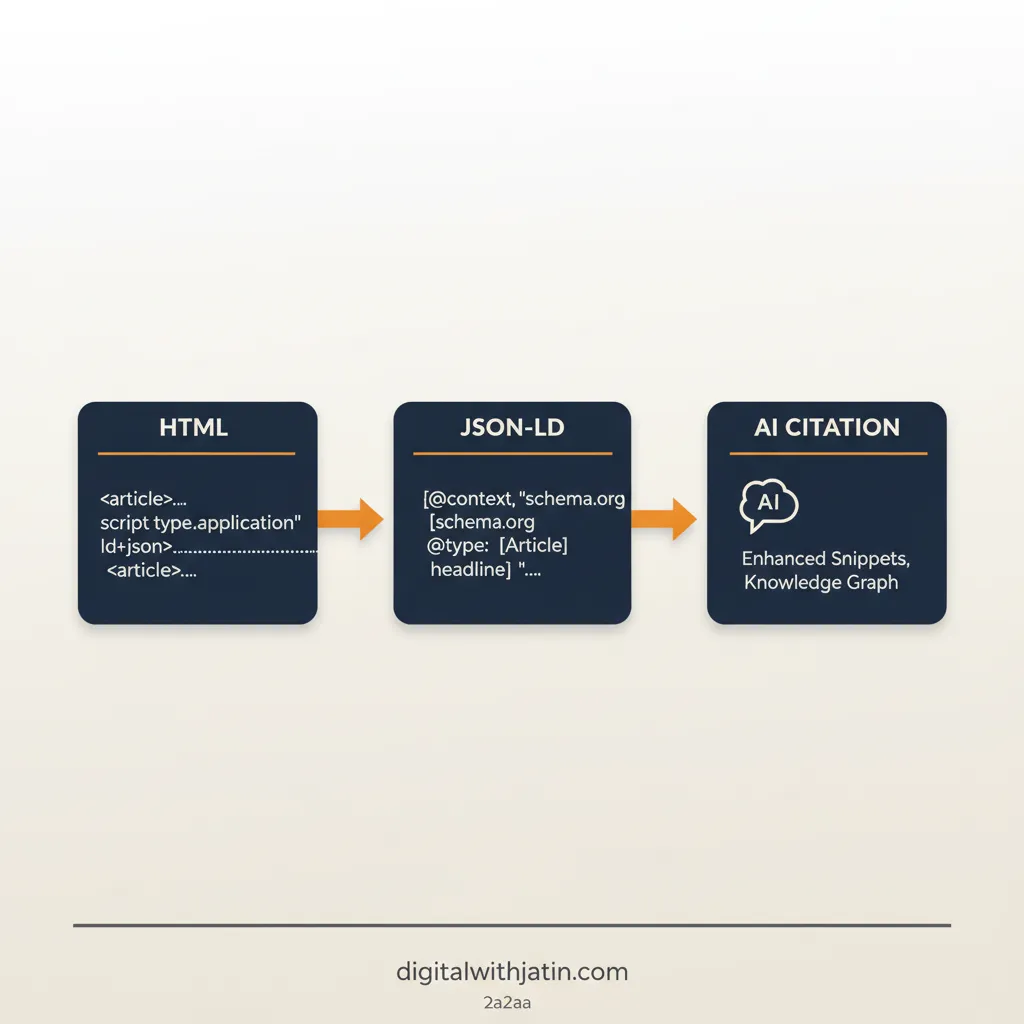
Structured data tells AI search systems what each section of a page is. Without it, an AI retrieval system reads your content as a block of text and must infer structure. With FAQPage schema, the retrieval system knows exactly where the questions and answers are and can lift them as standalone passages. With Article schema, it knows the author, the publication date, and the canonical topic.
The three schema types that matter most for AI search:
- FAQPage: makes individual Q-and-A pairs extractable. This is the single most citable page element for AI Overviews and Perplexity answers.
- Article: confirms authorship and publication date. Both are E-E-A-T signals and freshness signals simultaneously.
- HowTo: structures procedural content into numbered steps, which AI systems can present as a step-by-step answer.
Validate every schema block with the Google Rich Results Test before publishing. A malformed schema block that fails silently is worse than no schema, because it consumes implementation time with no return.
Foundation 3: Named entity clarity
AI search systems resolve entities. “Backlinko” is an entity. “Google Search Console” is an entity. “Jatin Lokwani” is an entity. “A leading SEO blog” is not.
Pages that reference entities by name, rather than vague descriptors, give retrieval systems something to anchor to. The retrieval embedding can confirm the entity exists in the knowledge graph and weight the passage higher because the reference is resolvable. Pages that use generic phrases (“according to experts,” “a recent study found”) give the system nothing to confirm.
The practical rule is one explicit named entity reference per major entity per post. Not every mention needs to be fully named, but the first mention and the most important mention should be.
Foundation 4: Passage-level content structure
AI answers are built from passages, not pages. A clean passage has one idea, clear language, and four sentences or fewer. A six-sentence paragraph with multiple embedded clauses is harder for a retrieval system to lift because the unit of meaning is not contained.
The most important passage on any page is the first paragraph under the first H2. This is where AI Overviews and Perplexity most often find the direct-answer block. Write a 50-to-60-word answer to the post’s core question here, in plain language, with no hedging. This one structural choice earns more AI citations than almost anything else on the page.
After that, each section heading should surface a specific claim or answer a specific question. Vague headings like “More Information” or “Background” produce vague passages. Specific headings like “What structured data matters most for AI Overviews” produce specific passages that retrieval systems can quote.
Foundation 5: Internal link depth
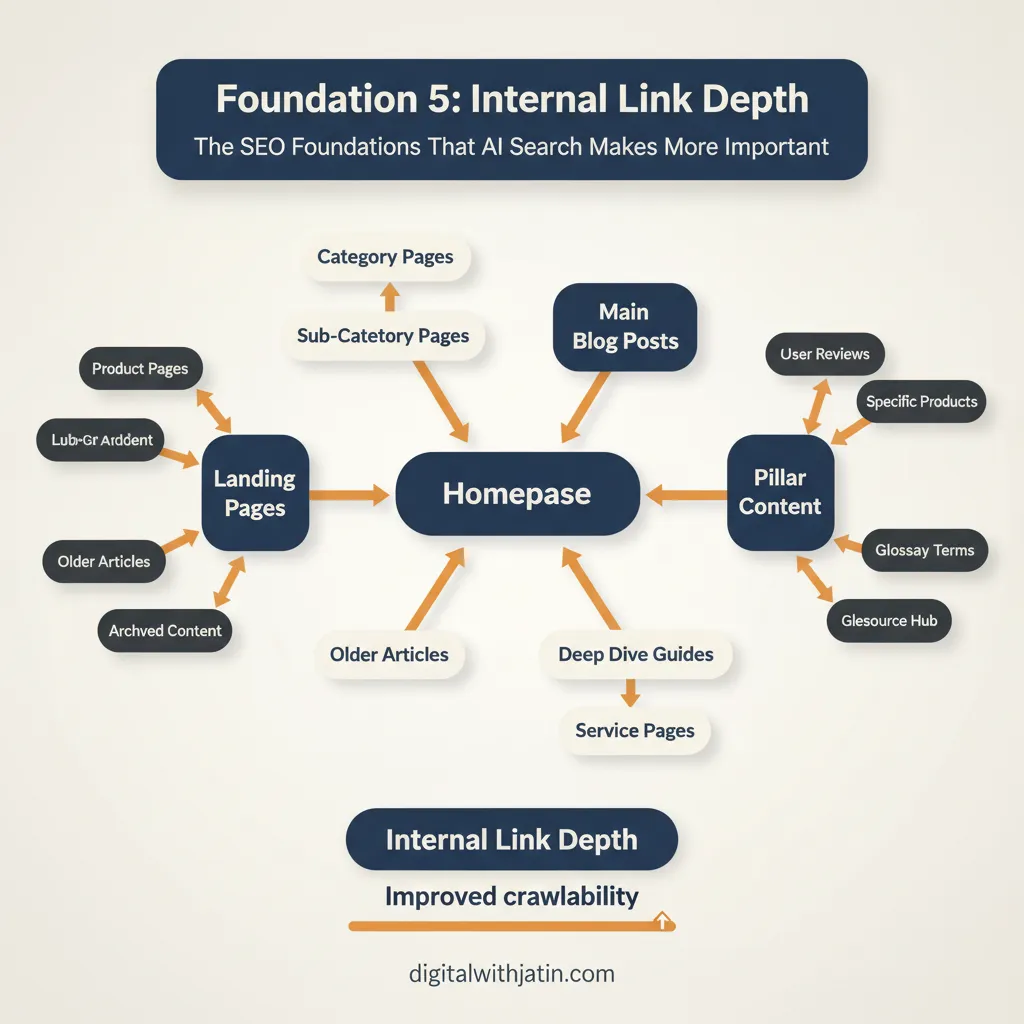
Internal linking is the structure that tells AI search systems a site has depth on a topic, not just one article. A pillar page linked to from ten cluster pages on the same topic signals topical authority more clearly than any single page regardless of its content quality.
For AI SEO, the internal link graph is topical depth made explicit. A retrieval system crawling your site finds a network of pages that all address different angles of the same topic. That network is a stronger authority signal than a single long-form post, even if the single post covers more ground.
The practical implication for AI SEO fundamentals work: build the cluster before you optimize individual pages. Ten interconnected pages on a topic earn more citations than one isolated masterpiece.
The mechanics of how internal linking changes for what AI simplifies in technical SEO work is worth reading alongside this section.
Foundation 6: Freshness signals with explicit date anchors
AI search weights freshness. A passage dated with an explicit month and year outranks an equivalent undated passage because the retrieval system can confirm the information is recent. An undated statistic could be from 2019. A statistic dated “as of March 2026” is clearly current.
The date must appear in three places: the frontmatter (for the CMS and sitemap), the rendered byline (for readers), and inline next to time-sensitive claims. “AI Overviews appeared on 15.69% of queries as of November 2025” is a citable, dated claim. “AI Overviews are growing” is not.
Update both the frontmatter date and the inline claims whenever the underlying data changes. A post that was accurate in 2024 and has never been updated is a freshness liability in 2026, regardless of how authoritative it once was.
How these six foundations feed AI citation
The foundations are not independent. They form a dependency chain.
Crawlability is the prerequisite. Without it, nothing else matters. Structured data is the labeling layer on top of crawled content. Named entities give retrieval systems anchors inside each passage. Passage structure determines whether a good passage is citable or buried. Internal links build the topical authority map. Freshness dating tells retrieval systems which passages to trust on time-sensitive queries.
A page that succeeds on all six is the strongest candidate for AI citation regardless of domain authority. A page that fails on crawlability fails at step one. A page that has strong content but no structured data and vague entity references will rank in classic search but be underrepresented in AI citations.
The honest observation from audit work: most sites that underperform in AI citations have a crawlability or structured data gap, not a content gap. Fix the foundation before you rewrite the content.
FAQ
What are the most important SEO elements for AI search?
Crawlability comes first, because an uncrawled page is invisible to AI search regardless of content quality. After that: structured data (FAQPage, Article, HowTo), named entity clarity, passage-level content structure, a strong internal link graph, and freshness signals with explicit date anchors.
Does technical SEO still matter with AI?
Yes, more than ever. AI search systems source their answers from indexed content. If a page is blocked to crawlers, has thin structured data, or uses vague entity references, it is not a candidate for AI citation. Technical SEO is the prerequisite layer, not an optional extra.
What is the most important foundation for AI SEO?
Crawlability. A page that is not crawled and indexed cannot be cited in any AI search surface, regardless of how well it is written or how much structured data it carries. Fix crawl and index coverage before any other SEO or AI SEO work. Everything downstream depends on it.
How does internal linking change for AI search?
Internal linking becomes more important for AI search because it signals topical depth to retrieval systems. A pillar page linked to from 10 cluster pages on the same topic is a stronger candidate for AI citation than an isolated page with equivalent content. The link graph is a topical authority signal, not just a PageRank signal.
What structured data matters most for AI Overviews?
FAQPage and Article schema are the highest-impact types for AI Overviews specifically. FAQPage schema makes individual Q-and-A pairs extractable as standalone passages. Article schema confirms authorship, publication date, and the canonical topic. HowTo schema helps for procedural queries. All three are straightforward to implement and validate.
The bottom line
The teams winning AI citations in 2026 are not the ones with the most sophisticated content strategy. They are the ones with clean crawlability, complete structured data, and explicit entity references throughout. These are not new ideas. They are the SEO basics, held to a higher standard.
If you want help auditing these foundations on a live site and mapping the gap to AI citation performance, the AI SEO service covers this as the first step of every engagement.