- An AI SEO strategy has four components: classic SEO foundations, AI search citation structure, multi-surface visibility, and AI-assisted execution.
- Most agencies and consultants only sell component 4 (AI tools for faster execution). That is not a strategy.
- Components 1 through 3 must be in place before AI tool usage produces meaningful results.
- This post defines each component precisely so you can audit what you currently have and what is missing.
Defining what is an ai seo strategy precisely matters more than it sounds. A SaaS brand came to me after six months with an AI SEO agency. They had a content calendar running at full pace, articles going out weekly, keyword research done by an AI tool, briefs generated in minutes. Traffic had not moved. When I audited the site, the technical crawl had 400+ errors the agency had never flagged. The domain authority sat at 14. There was no internal linking structure. The content was fast to produce but had nowhere to land in Google’s index. The agency had delivered component 4 of an AI SEO strategy and skipped components 1 through 3. This post exists so that does not happen to you.
What Is an AI SEO Strategy
An AI SEO strategy is a four-component plan covering: (1) classic SEO foundations, meaning crawl health, indexation, and domain authority, (2) an AI search citation layer built from passage structure, schema markup, and named entity clarity, (3) multi-surface visibility treating Google AI Overviews, ChatGPT, and Perplexity as distinct target channels, and (4) AI-assisted execution using tools to remove friction from research, content production, and reporting. A plan that only addresses component 4 is a tool stack, not a strategy.
Why the Definition Matters
The phrase “AI SEO strategy” is used loosely in most sales and marketing contexts. It usually means one of two things: a strategy that uses AI tools to do SEO faster, or a strategy that optimises for AI search surfaces. Both definitions are incomplete on their own.
Optimising for AI surfaces without the classic SEO foundation underneath is like building a floor without a frame. The content may be well-structured, but if the domain cannot be crawled, if the authority signals are absent, if the internal linking does not support topical depth, nothing gets indexed or cited. The signals are not there for any surface to read.
Using AI tools to accelerate execution without a citation-optimised content structure produces volume without visibility. Fast is not the same as effective.
The four-component model forces you to ask: which layers do I actually have, and which am I missing?
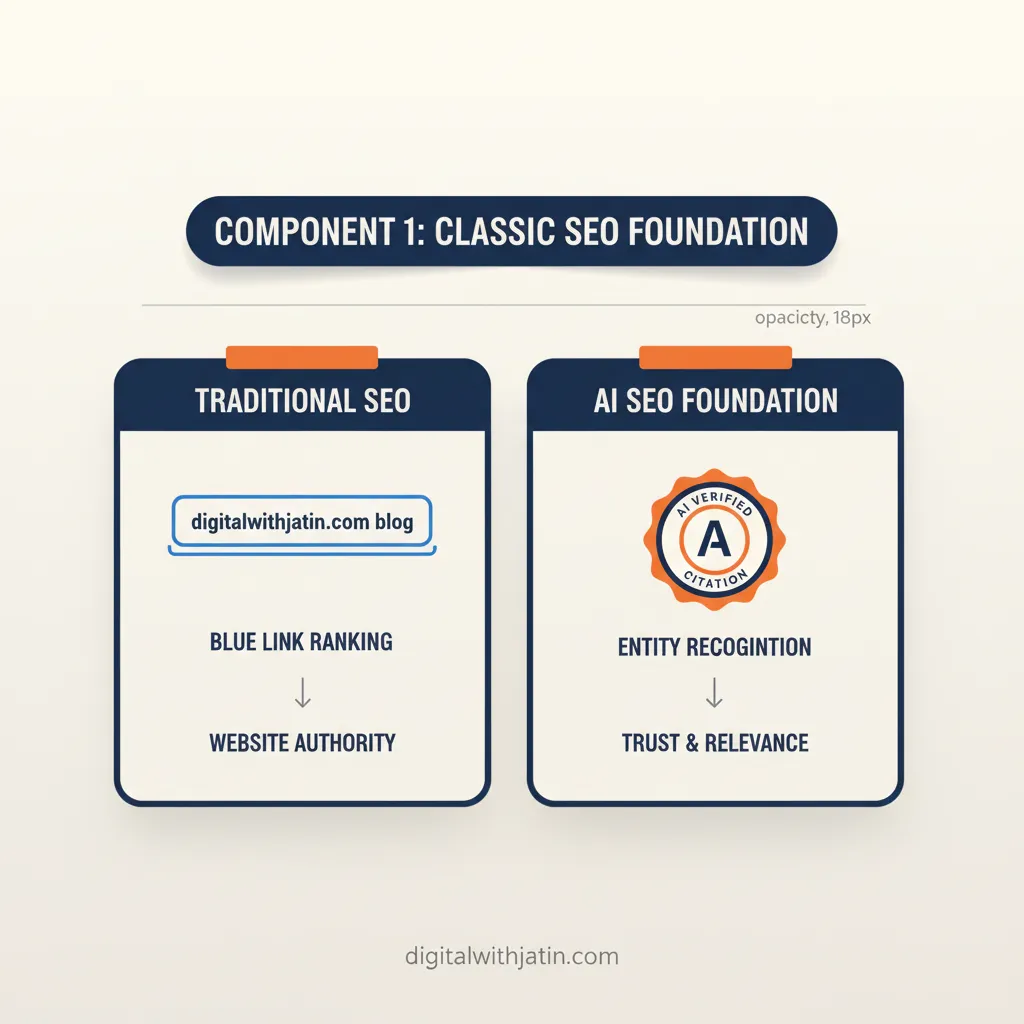
Component 1: Classic SEO Foundation
The first component is the one most people have at least partially. It covers everything that was true about SEO before generative AI arrived: technical crawlability, indexation health, domain authority, internal linking structure, and on-page fundamentals.
Crawlability means Google can access every page that should be indexed, and cannot access pages that should not be. A clean robots.txt, a valid sitemap, no redirect chains, no orphaned pages, no 4xx errors on linked URLs. These are baseline requirements, not optional extras.
Indexation means the right pages are in Google’s index and the wrong ones are not. Duplicate content, thin pages, and parameter URLs that should be noindexed are common problems that quietly dilute authority across a domain.
Domain authority is built through topical depth (covering a subject area with breadth and specificity) and external authority signals (links from relevant, credible sources). This takes time. There is no shortcut inside this component.
Internal linking creates topical clusters. It connects supporting content to pillar pages, signals topic authority to crawlers, and distributes page authority across the site in a controlled way. Most sites that claim to have an SEO strategy have poor internal linking because it is not the glamorous part of the work.
Without component 1 in place, components 2 and 3 produce much weaker results. The citation layer needs pages that are indexed and authoritative. You cannot cite a page Google cannot find.
Component 2: AI Search Citation Layer
This is the component most traditional SEO strategies are missing, and the one that directly affects whether your content appears in Google AI Overviews, Perplexity, or ChatGPT web search results.
Passage-level clarity means each section of your content answers a specific question in a self-contained way. AI search engines retrieve and surface passages, not full pages. A 2,000-word article that buries its answer in paragraph six is less likely to be cited than one where the answer appears in the first two sentences of a clear, labelled section.
Schema markup tells AI and traditional search engines what type of content they are reading. FAQPage schema increases the chance of appearing in rich results and AI Overviews for question-based queries. Article schema adds publication date and authorship signals. HowTo schema makes step-by-step content machine-readable. These are not advanced technical tasks. They are structured data formats that Rank Math, Yoast, or a custom JSON-LD block can handle. Not using them is leaving a signal layer empty.
Named entity clarity means your content explicitly and consistently names the people, brands, tools, locations, and concepts it covers. AI language models are trained on named entities and build semantic associations between them. Content that references entities clearly and correctly (and is referenced by other authoritative content covering those same entities) gets associated with those entities in AI knowledge graphs. This is the mechanism behind brand citation in AI responses.
For a technical breakdown of how this layer works with Google specifically, the post on how to get into Google AI Overviews for SEO covers the signal details.
Component 3: Multi-Surface Visibility
Traditional SEO had one primary target: Google’s organic results. An AI SEO strategy has at least four distinct surfaces, each with different citation mechanisms.
Google AI Overviews draw primarily from pages Google has already ranked well organically. The overlap between organic ranking and AI Overview citation is high, which is why component 1 is the prerequisite. But schema, passage clarity, and E-E-A-T signals push you from organic ranking into AI Overview citation specifically.
ChatGPT with web search browsing uses Bing’s index. A brand that ranks in Google but has weak Bing presence may rank well in Google AI Overviews but get skipped in ChatGPT responses. This is an underappreciated gap in most AI SEO strategies. Bing Webmaster Tools and Bing’s indexing API are part of the multi-surface strategy.
Perplexity operates its own crawler and cites sources directly in responses. It tends to favour structured, clearly sourced content from domains with visible authority signals. Getting cited in Perplexity responses requires the same passage clarity and schema signals as Google AI Overviews, but the domain authority threshold may differ.
Direct LLM training data is the fourth surface, and the one with the longest feedback loop. What ChatGPT, Claude, and Gemini “know” about a brand in their base training is shaped by what has been published on authoritative sources over time. This is where digital PR, guest placements, and Wikipedia presence start to matter for AI visibility in a way they never did for classic SEO.
Tracking performance across these surfaces requires tools that most traditional SEO reporting stacks do not include. Profound is currently one of the more capable options for monitoring AI citation across surfaces. Google Search Console covers the Google layer. Neither alone gives the full picture.
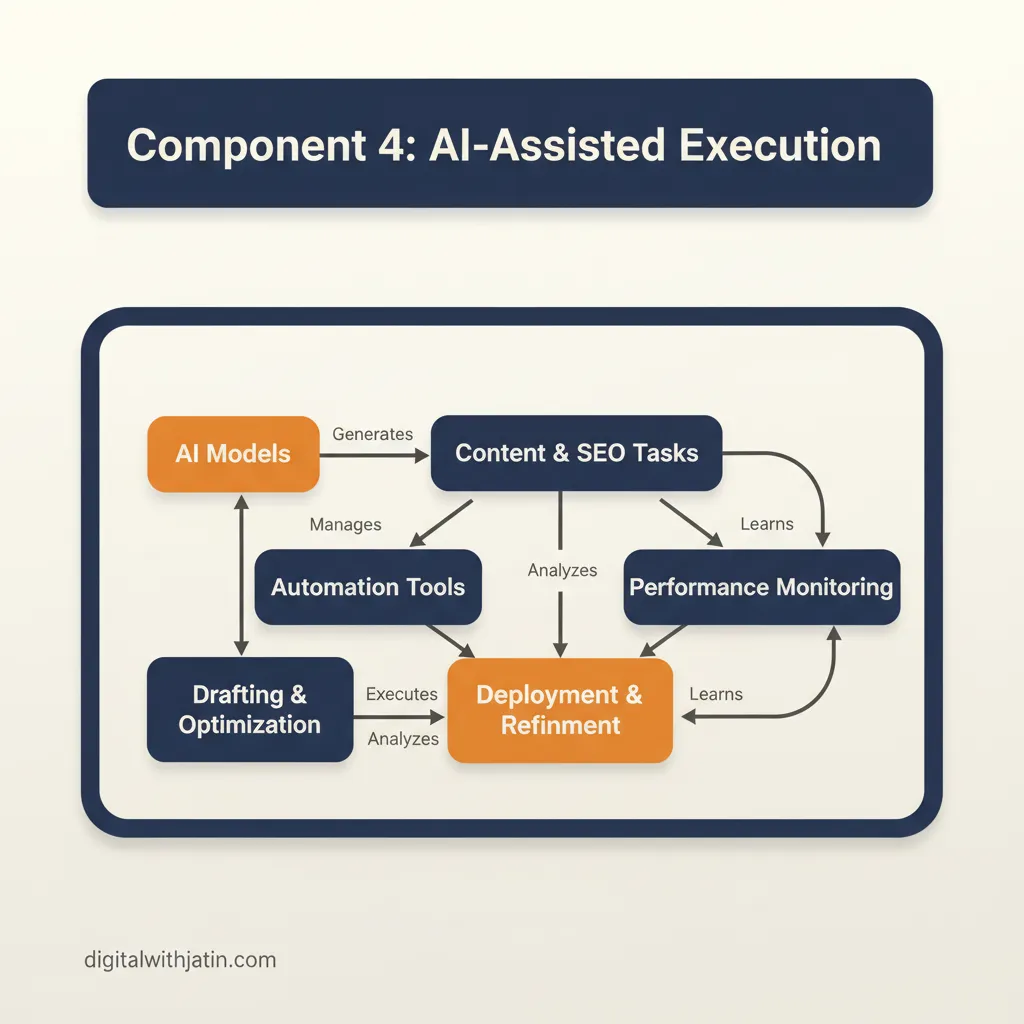
Component 4: AI-Assisted Execution
This is the component that gets the most attention and, on its own, the least strategic value. AI-assisted execution means using tools to remove friction from the research, production, and reporting parts of SEO work.
Claude and GPT-based workflows can handle keyword clustering, content brief generation, first-draft writing, schema code generation, and metadata writing at a pace no manual team can match. Used well, this compresses the gap between strategy and published content.
Ahrefs AI features handle competitive gap analysis and keyword opportunity identification faster than manual spreadsheet work. Surfer SEO scores content against the top-ranking pages for a target keyword, which removes the guesswork from content length and coverage depth. These are real time savings.
The risk is treating component 4 as the whole strategy. AI tools produce output fast. If the structure underneath (components 1 through 3) is weak, fast output means fast production of content that does not rank and does not get cited. The SaaS brand mentioned at the start had six months of that.
For a detailed breakdown of which AI execution tools are worth using and for what tasks, the post on what are the top AI tools for SEO covers the specific stack decisions.
How to Audit Your Current Strategy Against the Four Components
If you have an existing SEO strategy and want to check which components are actually in place, these are the practical audit questions.
For component 1: Run a technical crawl (Screaming Frog or Ahrefs site audit). What is your crawl error count? Are your core pages indexed? Do you have a clear internal linking structure connecting supporting posts to pillar pages? What is your domain rating and how does it compare to competitors for your primary keywords?
For component 2: Pick your ten most important content pages. Does each have custom JSON-LD schema? Do the opening paragraphs answer the target question directly without requiring context from the rest of the article? Do you explicitly name the entities your brand wants to be associated with?
For component 3: Search your brand name and primary services in ChatGPT, Perplexity, and Google AI Overviews. Are you being cited? If not, which surfaces mention competitors but not you? That gap tells you where the authority signal is missing.
For component 4: What percentage of your SEO workflow is still being done manually that could be templated or automated? Keyword clustering, meta descriptions, content briefs, and internal link mapping are all candidates for AI assistance without losing strategic control.
What is an AI SEO strategy?
An AI SEO strategy covers four components: classic SEO foundations (crawl, index, authority), AI search citation structure (passage clarity, schema, named entities), multi-surface visibility (Google AI Overviews, ChatGPT, Perplexity as separate targets), and AI-assisted execution (using tools to reduce workflow friction). A plan that addresses only the execution layer is a tool stack, not a strategy.
How is an AI SEO strategy different from traditional SEO?
Traditional SEO targets Google’s organic results. An AI SEO strategy also targets AI-powered answer surfaces: Google AI Overviews, ChatGPT with web browsing, and Perplexity. These surfaces use passage-level retrieval, schema signals, and named entity associations alongside traditional ranking factors. Optimising for them requires different content structure and tracking tools.
What are the four components of an AI SEO strategy?
The four components are: (1) classic SEO foundation covering technical health, indexation, and domain authority, (2) AI citation layer covering passage structure, schema markup, and named entity clarity, (3) multi-surface visibility across Google, Bing/ChatGPT, and Perplexity, and (4) AI-assisted execution using tools like Claude, Ahrefs, and Surfer to reduce time spent on repeatable tasks.
What AI tools are used in an AI SEO strategy?
The execution layer typically uses Claude or GPT for drafting and schema generation, Ahrefs for research and competitive analysis, Surfer SEO for content scoring, Google Search Console for organic performance tracking, and Profound for AI citation monitoring across surfaces. The tool stack exists to serve the strategy, not replace it.
Do I need all four components of an AI SEO strategy to see results?
Yes. Component 4 (AI tools) without components 1 through 3 produces fast output that does not rank or get cited. The foundation and citation layers are what AI surfaces actually read. Tools compress the time between decisions and published content. They do not substitute for the underlying structural work.
How long does it take to build an AI SEO strategy?
Technical foundations can be cleaned up in weeks. Authority signals take three to six months to build meaningfully. Citation layer signals (schema, passage clarity) show up in AI Overview tracking within four to eight weeks of implementation. AI-assisted execution reduces turnaround time immediately once the workflow is configured.
Is AI SEO strategy the same as GEO or AEO?
GEO (Generative Engine Optimization) and AEO (Answer Engine Optimization) are subsets of an AI SEO strategy. They refer specifically to component 3: optimising for citation in AI-powered answer surfaces. A complete AI SEO strategy includes GEO and AEO but also covers the classic SEO foundation and execution efficiency layers.
The SaaS brand from the introduction rebuilt their site’s technical foundation over two months, restructured their content for passage-level clarity, added schema to every content type, and only then restarted the AI-assisted content production. Within four months, they had first-page rankings for three of their target keywords and citations in Google AI Overviews for two informational queries. The tools were the same. The strategy underneath them was different.
If you want to know what building all four components looks like in practice, the AI SEO services page covers the full workflow.