- Parasite SEO is the practice of publishing content on high-authority third-party platforms to rank in search without building your own domain authority.
- AI dramatically scaled up parasite content production in 2023 and 2024, which triggered Google's March 2024 Core Update and spam policy changes.
- Post-2024, parasite SEO has much lower ROI than before. Host platforms are adding content quality filters. Google is penalising the practice more aggressively.
- It retains limited use in digital PR and genuine guest post placements on topically relevant sites. It is not a viable primary strategy.
Parasite ai seo became one of the fastest-growing grey-hat tactics in 2023 before Google systematically dismantled it. In early 2024, I was tracking a competitor who had built a strong keyword presence fast. No domain authority worth mentioning on their own site, but they were ranking for competitive terms across Forbes contributor articles, Medium publications, and a LinkedIn newsletter. The content was clearly AI-generated at scale. Every article followed the same structural template. Within three months of Google’s March 2024 update, most of those rankings were gone. The Forbes sub-directory took a significant traffic hit. The Medium posts dropped from page one to page four or beyond. The strategy that had looked effective for about six months had a cliff edge built into it. That is the story of parasite SEO in the AI era.
What Is Parasite AI SEO
Parasite SEO is the practice of publishing content on established, high-authority third-party platforms to rank in search using that platform’s domain authority rather than building authority on your own domain. AI changed the practice by making parasite content cheap to produce at volume. Google’s March 2024 Core Update changed the ROI by targeting this exact pattern. The term “parasite AI SEO” describes the intersection of these two developments: AI-scaled content published on third-party hosts to capture search rankings. Compare this with a sustainable AI SEO strategy that builds authority on your own domain over time.
How Parasite SEO Works
The mechanics are straightforward. Building topical authority on your own domain is the opposite approach — slow but compounding. Parasite SEO shortcuts that by publishing on a domain that has been building authority for years, say a major news publication, a large content platform, or an established industry site, passes ranking signals to any content published under its domain. A new article published on Forbes ranks faster for competitive keywords than the same article would on a new domain because Forbes has years of accumulated authority, crawl frequency, and link equity.
Parasite SEO exploits this by publishing content on these platforms not because the content genuinely belongs there, but because the platform’s authority makes the content rank. The publisher gets ranking. The platform gets content volume. The arrangement works for both parties as long as the content does not degrade the platform’s overall quality signals.
The problem is that the arrangement scales in a direction that eventually harms the host. When one publisher places a few carefully written articles on a relevant platform, both parties benefit. When thousands of publishers place AI-generated articles across the same platform indiscriminately, the platform’s content quality drops, its engagement metrics worsen, and eventually its authority erodes. The parasite damages the host.
How AI Scaled the Problem
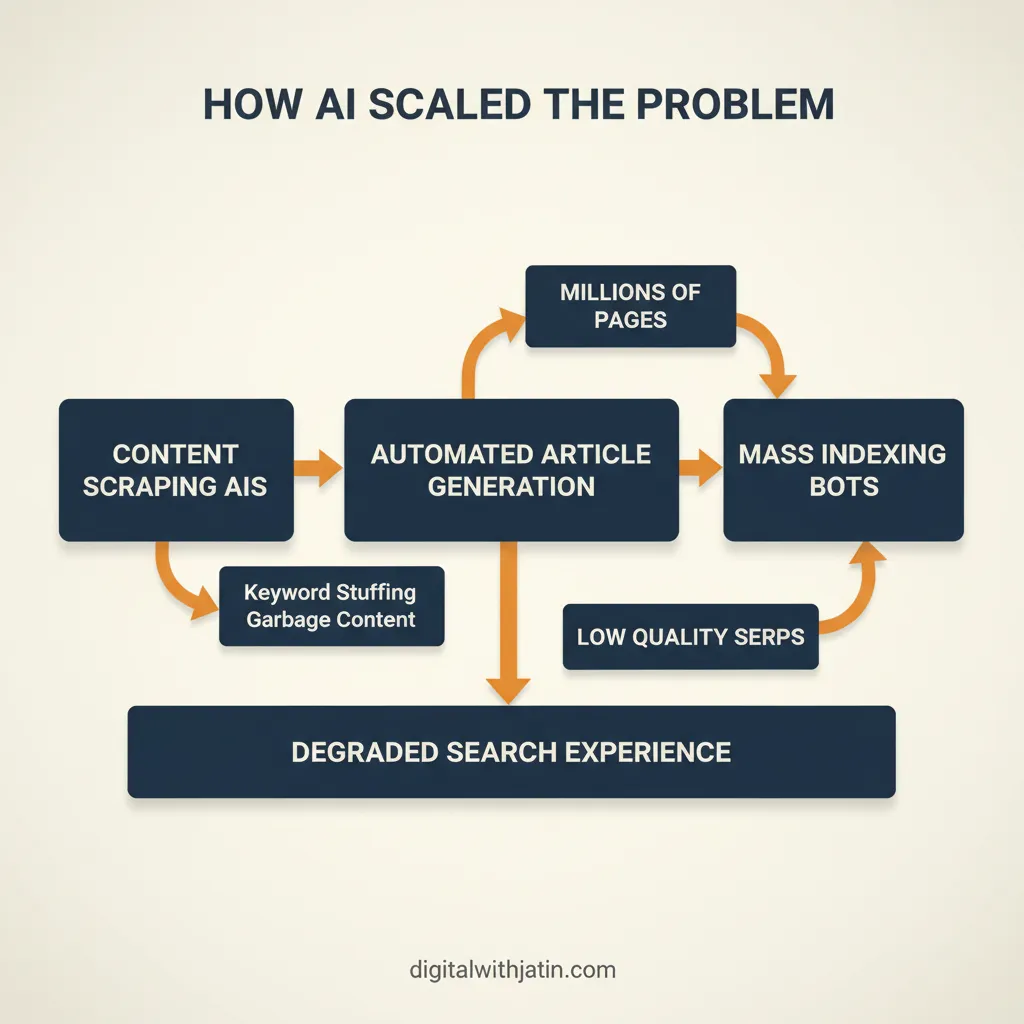
Before large language models were widely accessible, producing 50 keyword-targeted articles for Medium and 30 for LinkedIn Articles required a team of writers, several weeks of production time, and meaningful editorial oversight. The cost and time constraints naturally limited how aggressively the strategy could be applied.
After 2022, those constraints collapsed. A solo operator with access to GPT-4 or Claude could produce the same 80 articles in a weekend at near-zero marginal cost. The strategy that was previously available only to well-resourced teams became accessible to anyone with an API key and a keyword list.
The result was a significant increase in AI-generated parasite content across every platform with an open contribution model. Forbes contributor pages, Medium publications, LinkedIn newsletters, Substack, HubPages, and dozens of smaller platforms saw large volumes of templated, keyword-targeted, AI-generated content published through 2023 and into early 2024. Search results for some competitive informational queries became dominated by this content, because it was ranking on platform authority while the actual quality was thin.
Google had been watching this pattern for years. The March 2024 update was the formal response.
What Google’s March 2024 Core Update Did
Google’s March 2024 Core Update, documented at developers.google.com/search/blog/2024/03/core-update-spam-policies, explicitly introduced a policy against what Google called “site reputation abuse.” The policy describes the practice as: “when third-party pages are published with little or no first-party oversight or involvement, where the purpose is to manipulate Search rankings by taking advantage of the first-party site’s ranking signals.”
The update targeted this pattern algorithmically and through manual review. High-DA platforms that had allowed open contribution without sufficient editorial oversight saw significant ranking drops for their contributor content. Forbes’s sub-domain and contributor sections, documented by multiple SEO tracking tools in March and April 2024, lost a substantial portion of their organic visibility. CNN Underscored and similar editorially distinct sub-sections of major news sites were also affected.
The platform-level effect was significant because it changed the economics of parasite SEO at scale. The platforms that had been the most valuable “hosts” for this strategy became less authoritative as a direct result of being used at scale. The model was undermining its own foundation.
Where Parasite SEO Stands in 2026
The practice has not disappeared. The economics have changed.
Mass AI-generated content on open-contribution platforms no longer produces the search rankings it did in 2022 and 2023. Google’s spam detection has improved. Host platforms have tightened contribution standards. The platforms that were most heavily exploited have seen authority reductions that make them less effective hosts even for higher-quality content.
The legitimate version of the strategy has also narrowed in application. A guest post on a genuinely topically relevant publication with real editorial standards, covering a topic the site would publish regardless of SEO intent, still produces a backlink with authority signals and can appear in search. This is not meaningfully different from what guest posting was before “parasite SEO” became the framing.
What has changed is the volume playbook. Placing ten carefully written, topically relevant pieces across genuinely relevant publications still has SEO value. Placing 200 AI-generated pieces across any platform with a DA above 50 no longer produces the ranking returns it once did, and now carries the risk of the host platform itself being penalised.
The host platforms are also adding their own friction. Medium has introduced distribution controls that affect whether content reaches readers. LinkedIn’s algorithm deprioritises thin articles that get low engagement. Substack has editorial standards for its recommendations system. Even platforms with open publishing are finding ways to distinguish content that performs from content that is placed purely for search.
Where Parasite SEO Still Has Limited Legitimate Use
Two scenarios retain genuine value.
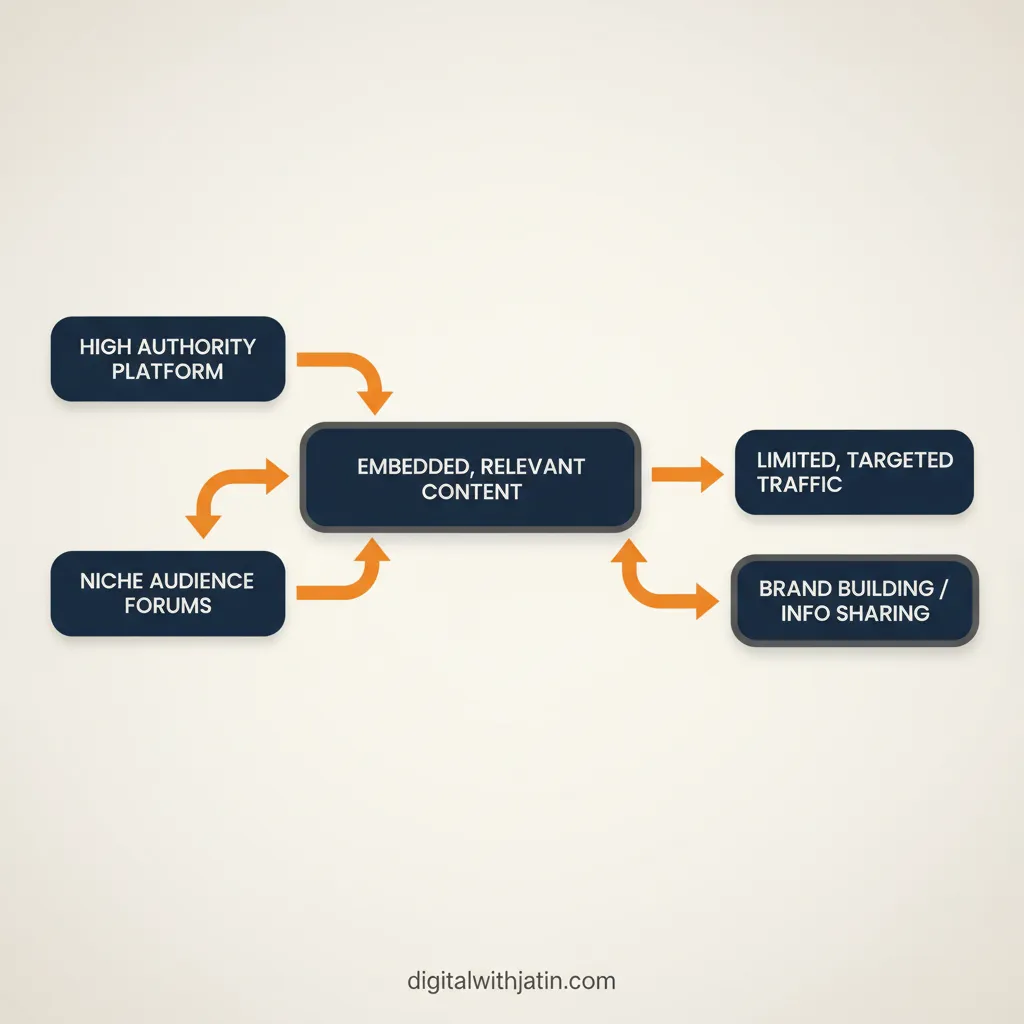
The first is digital PR. Getting a brand mentioned or featured in a genuinely editorial piece on an authoritative publication (a product review, an expert quote in a news article, a case study feature) produces authority signals and can appear in search results. This is distinct from parasite SEO in that the publication is making an editorial decision to cover the brand, not hosting content the brand published itself. Digital PR is a legitimate authority-building channel that happens to share some of the surface-level mechanics with parasite SEO.
The second is occasional guest post placements on topically relevant sites. A guest post on a marketing publication from an SEO practitioner, covering a topic the site would publish regardless of whether the author had an SEO goal, is a legitimate exchange. The publication gets credible content. The author gets a backlink and byline. This works at small scale, on genuinely relevant sites, with real editorial standards applied. It does not work at volume across tangentially relevant or unrelated sites.
Neither of these scenarios resembles the AI-scaled parasite content playbook that Google’s March 2024 update targeted. The scenarios that retain value are the ones that required editorial judgment and real relevance all along. The scenario that lost ROI is the one that AI made scalable.
For a broader look at how AI search surfaces evaluate content quality and citation signals, the post on will SEO be replaced by AI covers the structural shifts affecting search strategy.
The Risk Assessment for 2026
If you are currently using parasite SEO as a component of an SEO strategy, the risk assessment in 2026 looks like this.
Low risk: occasional, genuine guest posts on topically relevant sites with editorial standards, and digital PR placements in credible publications. These are sound practice regardless of what Google does next.
Medium risk: any placement on a platform primarily chosen for domain authority rather than topical relevance. The authority signal is real but diminishing, and the platforms are increasingly likely to reduce contribution access or apply their own quality filters.
High risk: mass AI-generated content placed across multiple platforms at volume, templated to rank for target keywords, with no genuine editorial relevance to the host platform. This is exactly what Google’s March 2024 update targeted and continues to address through its spam policies.
The honest summary: if a strategy required AI to be viable at the volume you are running it, and the volume is what made it work, the March 2024 update likely eliminated the ROI from that specific version. The version that required editorial judgment to execute was never the problem.
What is parasite SEO?
Parasite SEO is the practice of publishing content on established, high-authority third-party platforms to rank in search using that platform’s domain authority instead of your own. The publisher provides the content. The platform provides the ranking power. The strategy worked well before Google specifically targeted it in 2024.
How did AI change parasite SEO?
AI lowered the cost of producing parasite content to near-zero. Before large language models were accessible, scaling parasite content required significant writing resources and time. After 2022, the same volume could be produced rapidly at minimal cost, which caused a large increase in AI-generated parasite content across open-contribution platforms through 2023 and early 2024.
What did Google’s March 2024 Core Update do to parasite SEO?
Google’s March 2024 Core Update introduced a specific spam policy against “site reputation abuse”: third-party content published on high-authority platforms to exploit their ranking signals. Major platforms that had allowed open contribution without sufficient editorial control saw significant ranking drops for their contributor content sections.
Does parasite SEO still work in 2026?
In a limited form. Digital PR placements and genuine guest posts on topically relevant, editorially controlled publications still produce authority signals. Mass AI-generated content placed on high-DA platforms primarily for ranking purposes no longer produces the returns it did before March 2024, and now carries increased risk of both platform-level and algorithmic penalties.
What platforms are used for parasite SEO?
Medium, LinkedIn Articles, Substack, Forbes contributor pages, HubPages, and Quora Spaces have historically been used for parasite SEO. Post-2024, many of these platforms have added content quality controls or have seen reductions in the domain authority that made them attractive hosts. The platform list is narrowing as the hosts respond to the quality problem.
Is parasite SEO a recommended strategy?
No, not as a primary strategy. The risk profile has increased since Google’s March 2024 update. The ROI has decreased. Host platforms are adding quality filters. Building authority on your own domain is slower but produces compounding returns that platform-dependent placements cannot match. Parasite SEO is at best a supplementary tactic in its current, reduced-ROI form.
What is the difference between parasite SEO and legitimate guest posting?
Legitimate guest posting involves contributing genuinely useful content to a topically relevant publication with editorial standards, in exchange for a byline and backlink. Parasite SEO involves placing content specifically to exploit domain authority for ranking, regardless of editorial relevance. The practical difference is editorial judgment, topical fit, and whether the content would be published by the host independent of any ranking goal.
The competitor I was tracking at the start rebuilt after March 2024. They shifted to building content on their own domain, doing genuine digital PR outreach, and one or two guest posts per quarter on relevant industry publications. Eighteen months later, they have a domain authority that belongs to them, not borrowed from Forbes. The rebuilding took longer than the original parasite strategy. It will not collapse when Google updates its spam policies again.
If you want a strategy built on your own authority rather than borrowed platform power, the AI SEO services page covers how that is built from the ground up.